The Token Tax: The Physical Cost of Agentic AI
By Gaurav Dhir
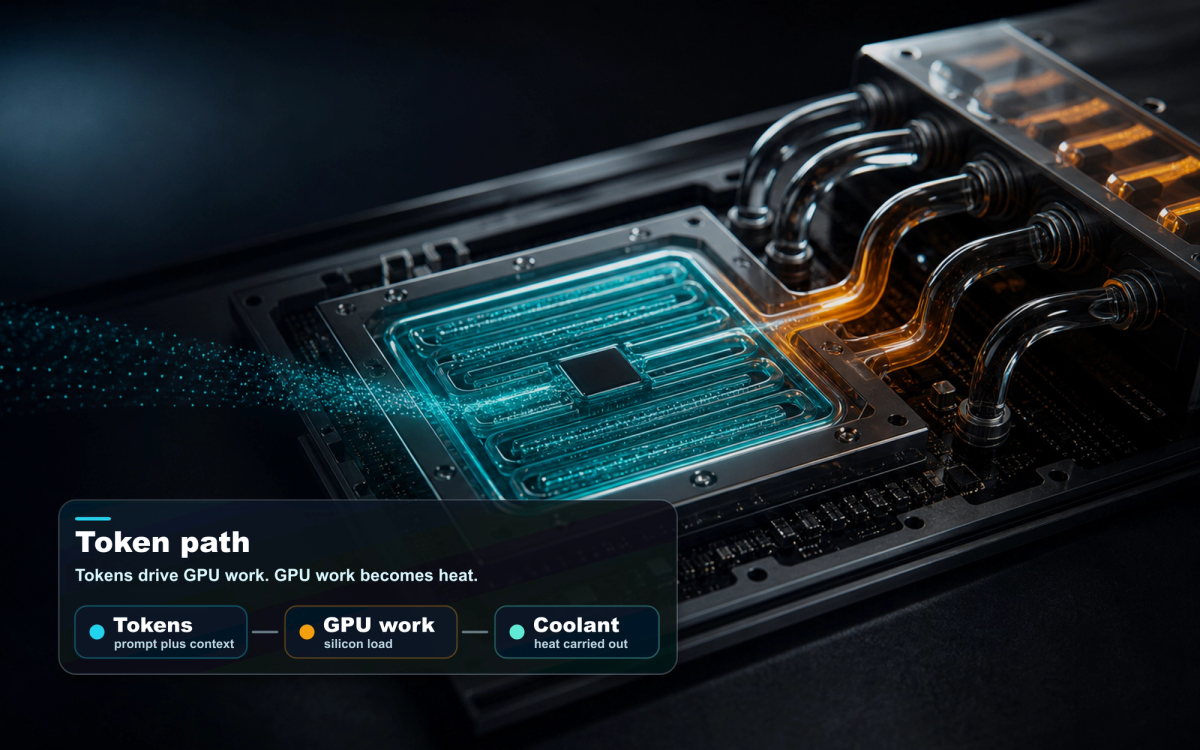
A token bill is like a restaurant receipt. It tells you what was charged. It does not show the kitchen, the staff, the line, the ovens, or the heat coming off the equipment.
An AI answer looks like words on a screen. Behind the glass, it is closer to a tiny factory shift: accelerators wake up, memory moves pallets of context around, tools get called, intermediate work gets checked, and heat leaves the silicon.
That is why tokens are useful, but also a little sneaky. They are easy to count on an invoice, but they are not the whole story of model economics. The goal is simple: learn to read a token bill like a heat map.
The bill says tokens. The rack sees heat. Once models reason for longer, call tools, and run as agents, that sentence stops being a metaphor. It becomes how AI infrastructure behaves.
This guide is for anyone buying, running, or planning AI systems: what tokens mean, what vendors actually disclose, why Claude, OpenAI, and open-weight models are priced differently, and why software cost eventually becomes a cooling question.
The short version
- Token price is not workload cost. A request can look cheap while creating long reasoning chains, tool calls, retries, and sustained load.
- The better metric is cost per accepted outcome. A model is cheap only when the completed job is cheap.
- Tokens are a proxy, not physics. The rack experiences computation, memory movement, power draw, and heat.
- Cooling readiness belongs in AI planning. Agentic workloads change time under load, coolant response, and operational margin.
What a token actually is
A token is not exactly a word. It is the chunk of text the model reads and writes internally. Sometimes a token is a whole word. Sometimes it is part of a word. Sometimes punctuation gets its own token. If words are groceries, tokens are the barcodes the model scans.
A token count is a useful proxy, not a physics measurement. Two jobs with similar token counts can create different infrastructure behavior depending on model size, batching, memory pressure, hardware utilization, tool calls, and time under load.
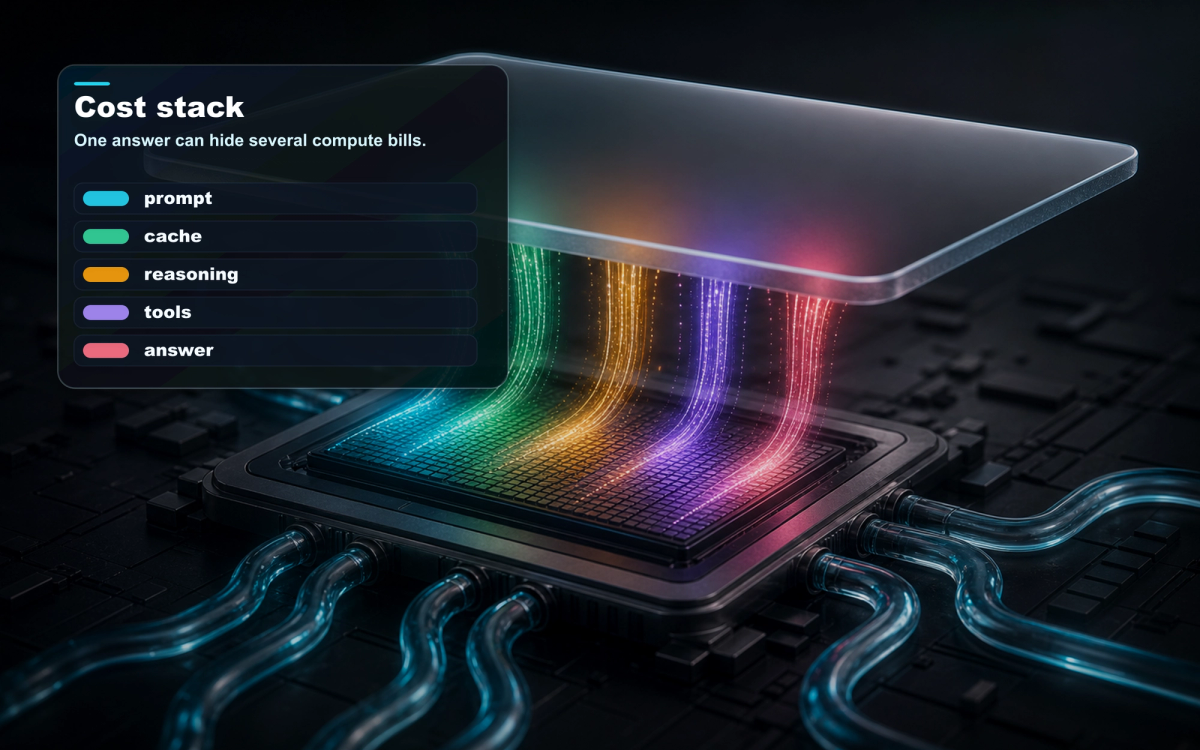
For buyers and operators, five token buckets are worth separating.
- Input tokens: the prompt, system instructions, retrieved context, tool results, files, and conversation history the model has to read.
- Cached input tokens: reused prompt or context that a provider can serve at a discount because the prefix is already stored.
- Visible output tokens: the answer the user sees.
- Reasoning or thinking tokens: hidden or summarized work the model may do before, during, or between visible output and tool calls.
- Internal compute: the true accelerator work behind the request. For closed models, vendors do not publish enough to compare this exactly.
A short answer can hide a long job
Imagine three AI jobs that all end with a one-paragraph answer. The screen looks similar. The workload behind it does not.
- Quick answer: about 800 input tokens, a short visible response, almost no hidden reasoning, and no tool calls. The request behaves like a quick compute pulse.
- Agentic support workflow: more context, several tool calls, hidden reasoning, and possibly a retry. The answer may still look short, but the job stayed active longer.
- Deep debugging task: large context, code inspection, tool use, verification, and long reasoning. The visible answer may be concise while the rack experiences a sustained workload.
Those examples are illustrative, not vendor benchmarks. The point is the shape: visible output is only one slice of the job.
That last bucket is the guardrail. Published token accounting and prices can be compared. Exact internal computation per request usually cannot, because closed model providers do not disclose the full accelerator work, routing, batching, caching, or serving stack behind each answer.
Public model prices are only the first layer
Treat public model pricing like a menu, not a full kitchen diagram. It tells you what is charged, not exactly how the serving stack produced the answer.
Model names change quickly, so the comparison below uses the public docs available on July 7, 2026: Claude Sonnet 5 and Claude Fable 5 from Anthropic, GPT-5.6 preview and GPT-5.5 from OpenAI, and current open-weight families such as Llama 4, Qwen3, DeepSeek V4 Preview, and Mistral 3.
Pricing note: AI model pricing, tokenizer behavior, reasoning controls, and model names change frequently. Treat this section as a dated snapshot, not procurement advice. Before buying or migrating workloads, recount your actual prompts against the exact model and pricing page you plan to use.
OpenAI currently documents GPT-5.5 as the flagship model for complex reasoning and coding, with GPT-5.4 mini and nano positioned for lower cost and latency. OpenAI has also previewed GPT-5.6 across Sol, Terra, and Luna sizes, with published preview pricing of $5, $2.50, and $1 per million input tokens, and $30, $15, and $6 per million output tokens respectively.
The important twist is that not every paid token appears on the screen. OpenAI says reasoning tokens are not visible through the API, but they still occupy context and are billed as output tokens. The usage object can expose reasoning_tokens, and OpenAI notes that complex tasks may use anything from a few hundred to tens of thousands of them.
Anthropic tells a related story in different terms. Claude Sonnet 5 launched with introductory pricing of $2 per million input tokens and $10 per million output tokens through August 31, 2026, then $3 and $15 after that. Anthropic also says Sonnet 5 uses adaptive thinking by default, with effort controls for thinking depth.
Claude Fable 5 sits at a higher price tier: $10 per million input tokens and $50 per million output tokens. Anthropic describes it as its most capable widely released model, built for demanding reasoning and long-horizon agentic work. Its docs also say adaptive thinking is always on for Fable 5 and Mythos 5, and raw chain of thought is not returned.
One more Anthropic detail matters for migration math: newer Claude tokenizers can produce roughly 30 percent more tokens for the same text than earlier models, depending on the workload. That does not mean the model is worse. It means old spreadsheets can lie. Teams should recount real prompts against the model they actually plan to use.
Open weights move the cost into operations
Open-weight models do not have one universal token price. Meta Llama 4 Scout and Maverick, Qwen3, DeepSeek V4 Preview, and Mistral 3 are all part of the open or open-weight conversation, but their economics depend on how they are served.
That is the major difference. With an API model, the bill arrives as a token price. With an open-weight deployment, the bill arrives as a machine curve: accelerators, memory bandwidth, quantization, batch size, KV cache behavior, routing, utilization, uptime, and the latency customers expect.
Self-hosting does not eliminate the token tax. It converts it into a utilization, reliability, and cooling-management problem. A self-hosted model can be cheaper at high volume when utilization is high and the workload is predictable. It can be more expensive when the cluster sits idle, latency targets block good batching, or the operations burden eats the savings.
Cheap tokens can still be expensive
The cheapest model per million tokens is not automatically the cheapest model per completed job. A cheap model that retries, calls the wrong tool, or produces work a human has to repair can lose to a more expensive model that finishes cleanly.
The useful metric is cost per accepted outcome. For a support agent, that might be cost per resolved ticket. For coding, cost per merged fix. For research, cost per usable brief. For data work, cost per correct analysis that survives review.
A model is cheap only if the completed job is cheap. Price per token is the starting line, not the finish line.
This is where reasoning gets tricky. More thinking can be wasteful on a simple task. It can also be the cheapest path on a high-value task if it prevents retries, bad tool calls, broken code, or human rework. The goal is not to worship the biggest model or chase the cheapest one. The goal is measured routing.
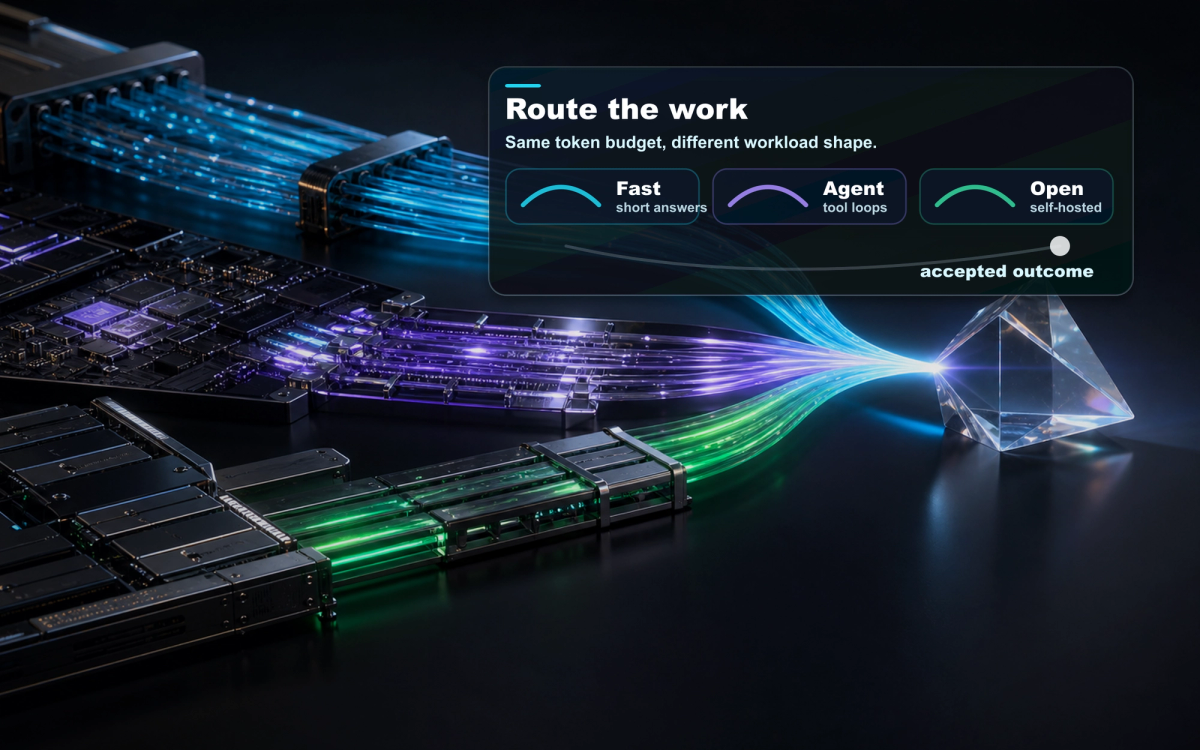
A practical routing matrix
- Simple, high-volume work: routing, extraction, classification, and controlled rewriting usually belong with small or fast models. Watch latency, caching, and retry rate.
- Operations and agent work: coding support, service workflows, and tool-using agents usually need a mid-tier frontier lane. Watch tool-call accuracy and review time.
- Complex reasoning: deep research, complex debugging, strategy, and hard verification often justify a flagship model. Watch cost per accepted outcome.
- Predictable self-hosted volume: privacy-sensitive or high-volume workloads can fit open weights when utilization, batching, memory pressure, and cooling stability are measured honestly.
A simple test helps. If the task is cheap to verify and easy to retry, a faster model usually deserves the first shot. If the task is hard to verify and expensive to get wrong, the stronger model may be the cheaper choice even at a higher token price.
But routing models intelligently only solves the software side of the equation. Once an agentic loop runs at scale, that software strategy immediately becomes a hardware problem.
Where the software bill becomes a cooling load
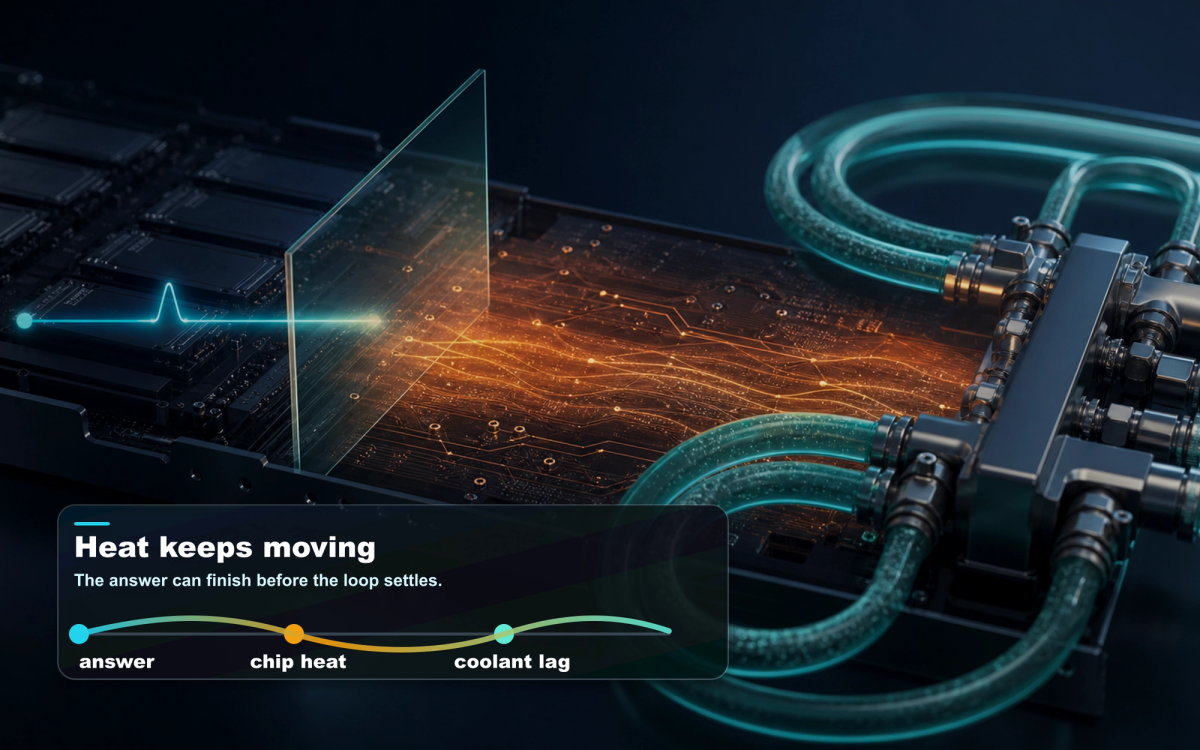
This is the handoff point: the AI team thinks the request is done when the answer appears. The cooling loop is still dealing with the tail. Cooling systems do not care whether a token was visible to a user or hidden inside a reasoning step. If the accelerator did work, the heat arrived.
This is the part most software-only cost models miss. Agentic AI changes not only the size of requests, but the shape of load. A simple chatbot is a quick tap on the rack. An agent is a drumbeat: read context, think, call a tool, read results, think again, call another tool, write, inspect, revise, and finish.
That longer chain can turn a bursty inference call into a sustained thermal event. It changes time under load, memory pressure, network traffic, pump and fan response, coolant temperature rise, and how much thermal margin the rack has left for the next wave.
This does not make every agent request an emergency. It means token economics and thermal operations are now connected. Model routing, context length, cache policy, output limits, and retry behavior all influence how much useful compute a data center can deliver per watt and per gallon of cooling effort.
The question is no longer only "What did the model cost?" It is also "What workload shape did we just ask the facility to absorb?"
Why the cooling loop needs intelligence
Reliability Engine is not here to pick the model for you. The bigger question is what happens after that model choice reaches the rack.
If reasoning-heavy workloads are going to run for longer, call more tools, and push denser racks harder, then the cooling loop needs to be treated as part of the AI system. Not background plumbing. Not a once-a-month lab report. A live operating layer across coolant health, flow behavior, thermal margin, and service history.
The useful signals are familiar: supply and return temperature, flow, pressure drop, pump effort, filter loading, conductivity, particles, metals, pH, inhibitor health, and service history. The value is in seeing those signals together while there is still time to act.
The future AI stack needs two kinds of intelligence. One predicts the next token. The other protects the physical path that makes those tokens possible.
A simple checklist before you scale
- Count tokens on the exact model you plan to use, not on an older tokenizer or a similar model name.
- Track accepted outcome cost, not only price per million tokens.
- Separate input, cached input, visible output, and reasoning or thinking tokens in your logs wherever the provider exposes them.
- Set model routing by task risk: cheap to retry, expensive to fail, latency critical, privacy sensitive, or long-horizon.
- Measure retry rate, tool-call count, context growth, and output length. These are cost signals and infrastructure signals.
- For self-hosted models, report utilization, batching efficiency, memory pressure, and cooling stability alongside token throughput.
- Compare thermal behavior at similar workload mixes, not only at similar peak power. Time under load matters.
The takeaway
Tokens are how AI work becomes billable. Heat is how AI work becomes physical.
The winners will not be the teams that buy the biggest model for everything or the cheapest model for everything. The winners will route work intelligently, measure outcomes honestly, and keep the racks healthy enough to turn model capability into reliable capacity.
Planning AI workloads?
Check the loop before the load arrives. Reasoning-heavy AI changes time under load, coolant behavior, and operational margin. Reliability Engine monitors the physical path that turns model capability into reliable capacity.
Schedule an AI Cooling Readiness Review or use the checklist above to pressure-test routing, token logging, and cooling-loop readiness before the next workload wave.
Subscribe to updates
Get the latest engineering perspectives sent straight to your inbox.
References
- OpenAI: Previewing GPT-5.6 Sol
- OpenAI API docs: Models
- OpenAI API docs: Reasoning models
- Anthropic: Introducing Claude Sonnet 5
- Anthropic Platform docs: Pricing
- Anthropic Platform docs: Token counting
- Anthropic Platform docs: Claude Fable 5 and Claude Mythos 5
- Anthropic Platform docs: Effort
- Meta AI: Llama 4 multimodal intelligence
- Qwen: Qwen3, Think Deeper, Act Faster
- DeepSeek API docs: DeepSeek V4 Preview Release
- Mistral AI: Introducing Mistral 3