Bessemer Included Reliability Engine in the AI Data Center Stack
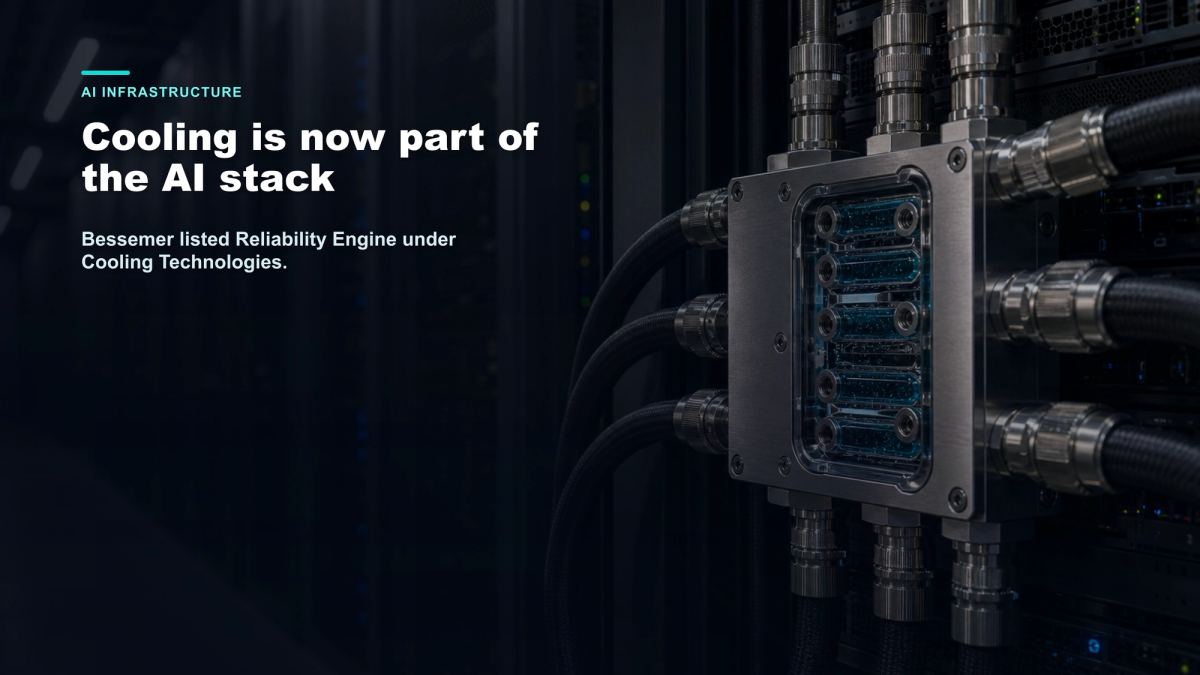
Most AI data center stories start with compute. That makes sense: compute is visible, expensive, and easy to point at. But once the racks are running, another question shows up fast: can the cooling loop keep that compute stable, day after day?
That is why Bessemer Venture Partners' May 19, 2026 roadmap on the AI data center stack is worth noting. It puts the physical systems of AI infrastructure into the same conversation as chips and software. Cooling is one of those systems.
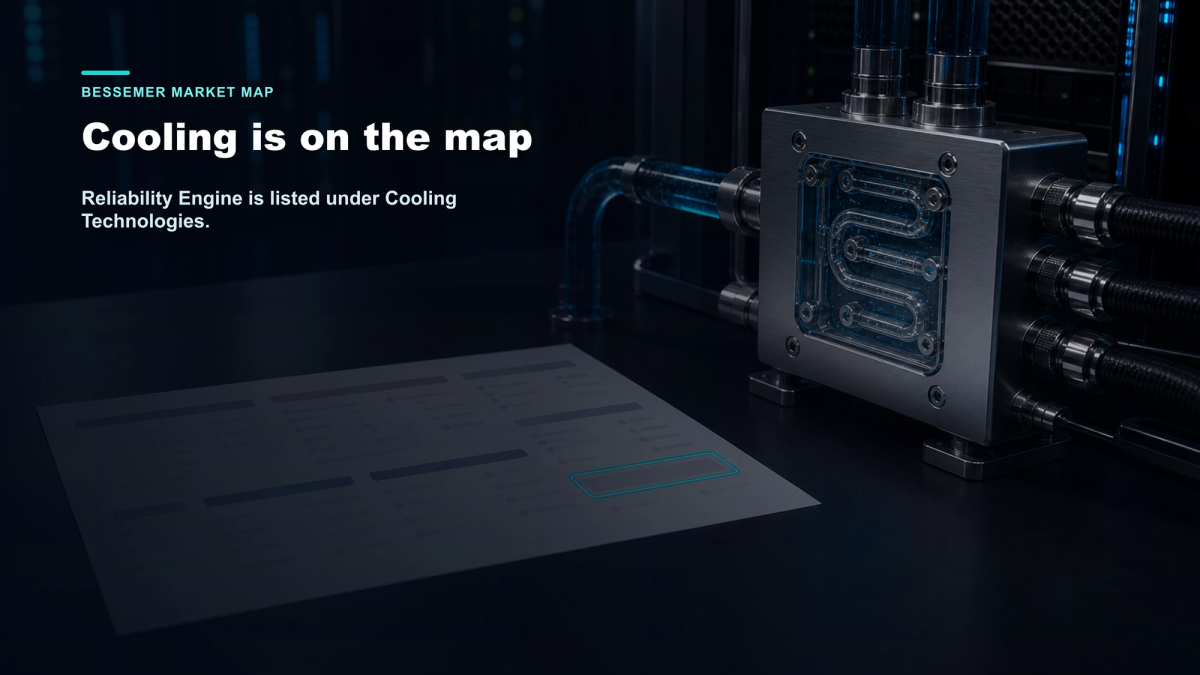
Reliability Engine was listed by Bessemer Venture Partners in its AI data center stack market map under Cooling Technologies. That matters because cooling is no longer a back-room facilities detail. For dense AI racks, it is part of whether installed compute can stay useful under real workloads.
This is a market-map placement, not a funding, endorsement, or partnership announcement. The simple point is that Bessemer names Cooling Technologies as part of the AI data center stack.
Why The Map Matters
The map did not make cooling important. The racks already did that. What it does is make the operating reality easier to see: AI capacity depends on power, heat removal, site readiness, service discipline, and data the team can trust.
A race car is a useful way to think about it. The engine gets the poster, but races are won by cooling, fuel, brakes, tires, telemetry, and the crew reading the data. A brilliant engine with bad telemetry is still a risky machine.
High-density AI infrastructure works the same way. Great hardware can still lose usable capacity if heat does not leave cleanly, evenly, and predictably. Cooling is not a footnote. It is part of the customer experience when jobs slow down, throttle, or become harder to trust.
A good coolant loop is not just plumbing. It is closer to a bloodstream with lab work attached: the fluid moves heat, the chemistry shows whether the path is staying clean, and the trends show whether the loop still behaves like it did on day one.
Cooling Is Now A Buying Question
The old question was simple: can we cool it? The better question now is: can we show that the loop is still doing what it was built and commissioned to do?
That matters because liquid alone is not the breakthrough. The real value is a loop that keeps the thermal path stable, protects hardware, and gives the team warning while the problem is still small.
Where Reliability Engine fits
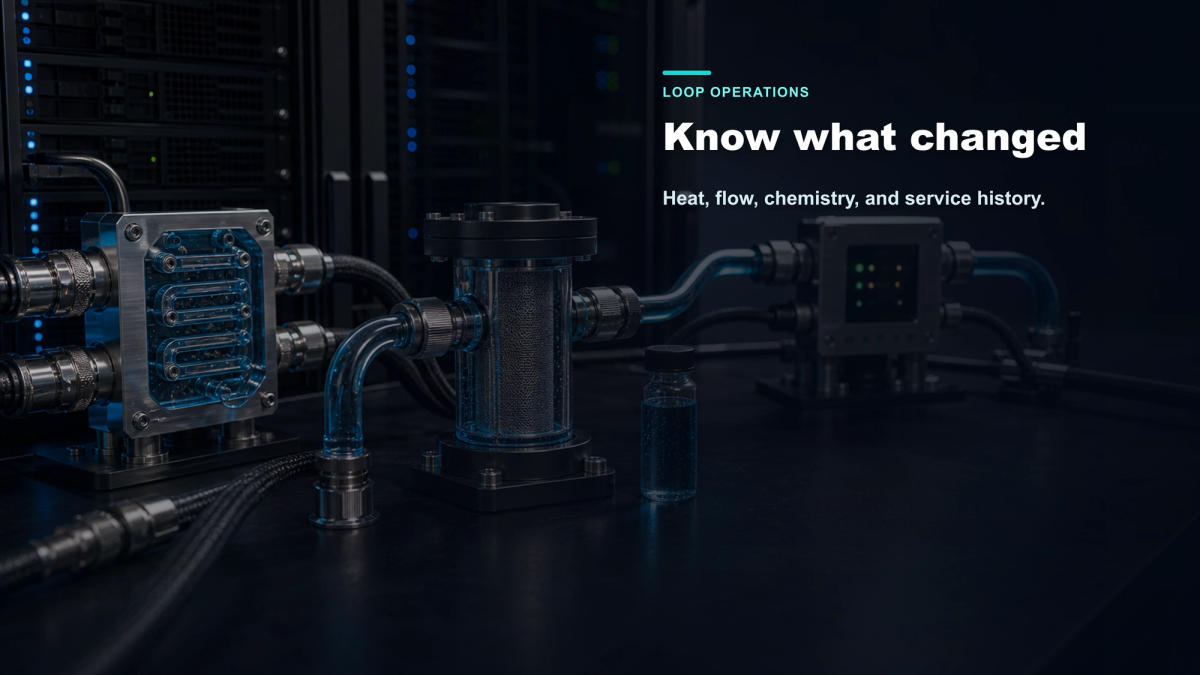
Reliability Engine connects cooling hardware to operating decisions. A cold plate removes heat. A pump moves fluid. A control system chases a setpoint. Teams still need to know whether the loop is clean, stable, balanced, and changing in a way that deserves action.
That is not always visible in temperature alone. Clear coolant can carry dissolved ions. A filter can load slowly. Flow and pressure can shift before a thermal alarm appears. Chemistry can change after fill, service, construction, or a supplier change.
That is the job Reliability Engine is built for: turning the cooling loop from a black box into a system teams can compare against a baseline. Not just "is it cold today?" but "is it still behaving like the system we trusted on day one?"
Questions Worth Asking
If you run, buy, or build liquid-cooled AI infrastructure, the practical lesson is simple: do not leave cooling in the background. Treat it as a system with baselines, trends, and operating history.
Start with questions teams can actually answer:
- Are we getting the same thermal result at the same flow, pressure, and pump effort?
- Are conductivity, particles, metals, pH, or inhibitor signals moving faster than expected?
- Did the loop change after a fill event, service event, commissioning step, or construction handoff?
- Can facilities, IT, vendors, and leadership look at the same data and agree on what changed?
- Can the team act while the issue is still small, instead of waiting for a hard alarm?
These are capacity, maintenance, and operating-risk questions. They belong in the same conversation as uptime, utilization, and customer commitments.
The takeaway
Bessemer's AI data center stack is useful because it shows AI infrastructure as a physical system. Power has to arrive. Heat has to leave. The site has to be built, operated, and trusted under real workloads.
Reliability Engine's placement under Cooling Technologies is one sign of that shift. The next generation of data centers will not be judged only by how much compute they install. They will be judged by how much useful compute they keep available.
The best cooling loop does more than run cold. It helps teams see trouble early enough to act.
Subscribe to updates
Get the latest engineering perspectives sent straight to your inbox.