AI data centers are moving faster than traditional manual cooling checks can scale. The operating layer has to understand the loop before margin disappears.
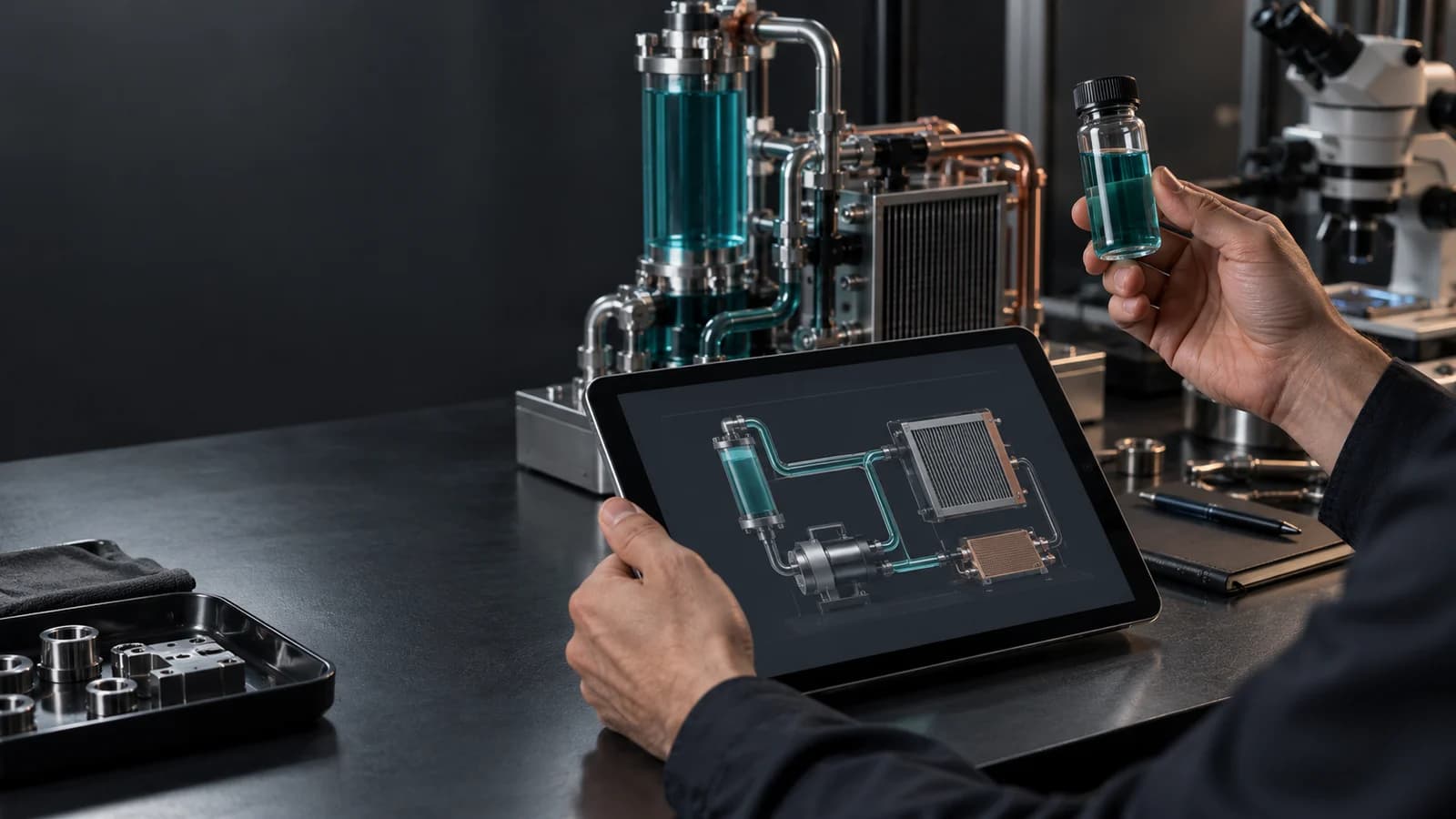
About Reliability Engine
About
Deep Coolant, Chemistry, and Reliability Expertise for Liquid-Cooled AI Infrastructure
Reliability Engine exists because liquid-cooled AI infrastructure needs a reliability layer that understands coolant chemistry, thermal systems, loop behavior, and GPU output together.
Our multidisciplinary team brings together engineers, chemistry specialists, data scientists, and field reliability expertise, including PhD-level knowledge of coolant, corrosion, and materials.
The work sits at the intersection of coolant chemistry, fluid and thermal systems, reliability engineering, controls, telemetry, and applied data science.
We focus on chemistry and data that help teams inspect earlier, maintain smarter, and protect GPU output.
Explore the signal flow
Coolant chemistry
PhD-level chemistry expertise focused on coolant behavior, degradation, contamination, inhibitors, and materials risk.
Thermal systems
Experience with coolant, corrosion, reliability, and thermal challenges across demanding automotive, OEM, industrial, and infrastructure environments.
Data science
Models and workflows for anomaly detection, telemetry correlation, baseline drift, and predictive reliability.
Operations
A field-aware view of CDUs, manifolds, cold plates, filtration, maintenance, and operator decisions.
One operating viewChemistry, rack measurements and operating context
A clear next checkInspect, sample and verify recovery
How Reliability Engine works
From cooling measurements to maintenance decisions.
Monitor the loop
Track coolant health, temperature, pressure and flow.
Compare with GPU load
Read loop changes alongside rack and GPU signals.
Check likely causes
Look for coolant changes, restrictions or workload effects.
Choose the next check
Prioritize sampling, inspection or maintenance.
What this helps you see
Coolant chemistry
PhD-level chemistry expertise focused on coolant behavior, degradation, contamination, inhibitors, and materials risk.
Thermal systems
Experience with coolant, corrosion, reliability, and thermal challenges across demanding automotive, OEM, industrial, and infrastructure environments.
Data science
Models and workflows for anomaly detection, telemetry correlation, baseline drift, and predictive reliability.
Operations
A field-aware view of CDUs, manifolds, cold plates, filtration, maintenance, and operator decisions.
Capabilities the market needsView table
| Capability | Why it matters | Reliability question | Reliability Engine focus |
|---|---|---|---|
| Coolant chemistry | Fluid health can change before thermal symptoms appear. | Is the coolant still protective? | Track chemistry, particles, inhibitor health, and contamination risk. |
| Thermal and fluid systems | Cooling hardware behavior determines margin. | Is the loop still moving heat predictably? | Read CDUs, manifolds, flow, pressure, cold plates, and filters together. |
| Data science and ML | Noisy signals need pattern recognition. | Is this normal workload movement or real drift? | Build baseline, anomaly, and correlation logic. |
| Reliability engineering | Signals only matter when they change decisions. | Where does the team look next? | Guide inspection, sampling, maintenance, and controlled response. |
Coolant chemistry
- Why it matters
- Fluid health can change before thermal symptoms appear.
- Reliability question
- Is the coolant still protective?
- Reliability Engine focus
- Track chemistry, particles, inhibitor health, and contamination risk.
Thermal and fluid systems
- Why it matters
- Cooling hardware behavior determines margin.
- Reliability question
- Is the loop still moving heat predictably?
- Reliability Engine focus
- Read CDUs, manifolds, flow, pressure, cold plates, and filters together.
Data science and ML
- Why it matters
- Noisy signals need pattern recognition.
- Reliability question
- Is this normal workload movement or real drift?
- Reliability Engine focus
- Build baseline, anomaly, and correlation logic.
Reliability engineering
- Why it matters
- Signals only matter when they change decisions.
- Reliability question
- Where does the team look next?
- Reliability Engine focus
- Guide inspection, sampling, maintenance, and controlled response.
Common questions
What does Reliability Engine do?
Reliability Engine reads coolant health, flow, pressure, thermal drift, and GPU context together so AI data center teams can protect liquid-cooling reliability.
What expertise does the Reliability Engine team bring?
Our team combines PhD-level chemistry expertise with thermal engineering, software, data science, and field reliability. Experience with coolant, corrosion, materials, and demanding industrial systems informs our work on liquid-cooled AI infrastructure.
Is Reliability Engine only a sensor company?
No. The work is the reliability intelligence layer that connects coolant, hydraulic, thermal, and workload signals to operating decisions.