A monitoring device and software that connect coolant condition, loop behavior, and available GPU signals in one operating view.
Virtual Chemist
Liquid cooling intelligence
A live read on coolant health for liquid-cooled AI.
Virtual Chemist combines a side-stream coolant-monitoring device with software for liquid-cooled AI data centers.
- Side-stream sample
- Optical sensing
- Coolant condition
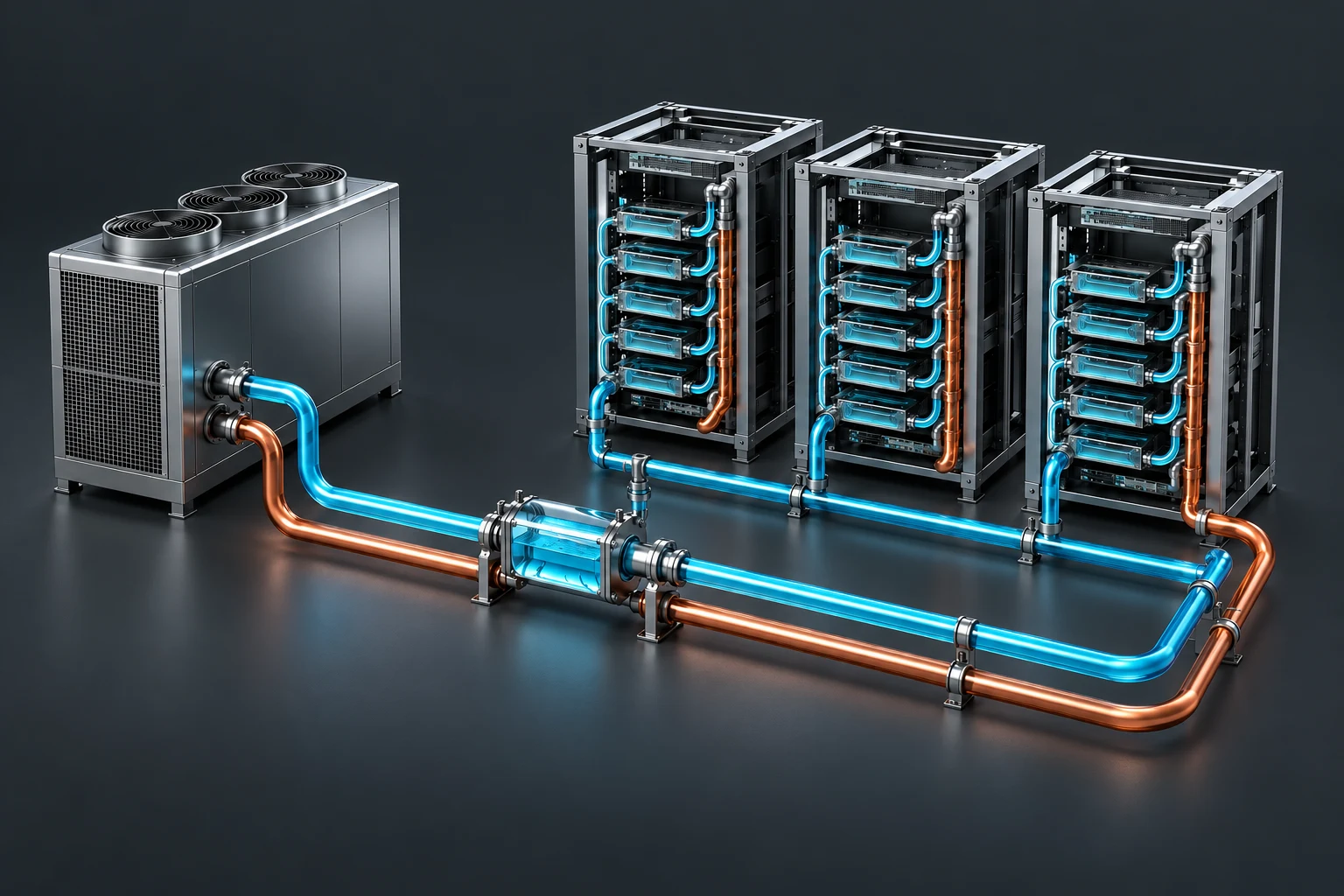
Read the fluid.A side-stream view tracks coolant condition without interrupting primary flow.
It brings coolant chemistry together with cooling-loop telemetry and available GPU context, helping operators understand what changed, why it matters, and what to check next.
Temperature alone does not explain a cooling problem. Fluid condition, flow, workload, and service history help teams work out what needs attention.
Investigate likely causes, prioritize sampling or maintenance, and check whether the loop recovered after an intervention.
Explore the signal flow
Circulating coolantSide-stream sensing
Loop chemistry
Conductivity, glycol concentration, pH, local corrosion trend (LPR) and turbidity.
How it helps your team
- Live coolant health
- Loop telemetry context
- GPU thermal signal
A side-stream device and software layer turn chemistry, flow, pressure, filter, service, and DCGM signals into clear alerts and recommended next actions.
Install without disruption
A side-stream device watches coolant health without interrupting primary flow.
See risk earlier
Chemistry, flow, pressure, filter, and temperature movement are read together.
Protect useful GPU output
Coolant and flow signals, read with NVIDIA DCGM context, help teams act on cooling-related throttling that can reduce token throughput.
Act with confidence
Alerts, diagnostics, and APIs show what changed, why it matters, and what to do next.
Will cooling drift affect GPU output?
Reliability Engine connects coolant health, loop behavior, and GPU thermal context so teams can see risk before throttling or downtime.
Where should the team look first?
The product points operators toward the loop, branch, filter, coolant, or rack pattern that changed from baseline.
What action comes next?
Alerts and APIs support sampling, inspection, filtration, rebalancing, maintenance planning, and workload protection.
We build the chemistry and data layer that powers liquid cooling, turning the world's most critical systems from reactive monitoring to predictive reliability.
How Reliability Engine works
From cooling measurements to maintenance decisions.
- WatchSide-stream coolant
- ReadLive chemistry movement
- CompareRack and GPU context
- GuideOperator next step
Monitoring capabilities
Product architecture
A side-stream coolant view, tied to the rack.
The product starts with the fluid, then adds the context needed to decide whether the loop is healthy, drifting, or asking for attention.
Coolant health now
pH, conductivity, turbidity, particles, inhibitors, contamination, and corrosion risk move from lab-only checks into the operating view.
Loop and GPU context
Pressure, flow, filters, service events, workload, and DCGM signals keep chemistry tied to what the rack is doing.
Why it changed
Baselines and drift logic help separate normal workload movement from fluid, hydraulic, or heat-transfer risk.
What to do next
Teams get alerts, APIs, diagnostics, and next steps they can verify after sampling, cleaning, conditioning, or rebalancing.
What this helps you see
Chemistry state
Track pH, conductivity, turbidity, particles, inhibitors, corrosion risk, and contamination signals.
Loop telemetry
Read CDU, rack, flow, pressure, filter delta, temperature, and device health in one context.
GPU context
Connect coolant behavior with NVIDIA DCGM thermal slowdown, hotspot, workload, and output signals.
Operator action
Explain what changed, why it matters, whether GPU output is at risk, and what to do next.
From raw chemistry to operating intelligenceView table
| Input | Context | Intelligence | Action |
|---|---|---|---|
| Chemistry telemetry | pH, conductivity, turbidity, particles, inhibitors. | Fluid condition and contamination risk. | Sample, condition, filter, or keep watching. |
| Loop telemetry | Pressure, flow, filter behavior, thermal response. | Hydraulic and heat-transfer drift. | Inspect affected path or rebalance branch behavior. |
| GPU context | Workload, thermal margin, output, throttling. | Whether loop drift is affecting compute. | Protect output or validate normal movement. |
| Maintenance history | Recent service, cleaning, fluid changes, filter events. | Whether a change is expected or abnormal. | Verify recovery before updating the baseline. |
Chemistry telemetry
- Context
- pH, conductivity, turbidity, particles, inhibitors.
- Intelligence
- Fluid condition and contamination risk.
- Action
- Sample, condition, filter, or keep watching.
Loop telemetry
- Context
- Pressure, flow, filter behavior, thermal response.
- Intelligence
- Hydraulic and heat-transfer drift.
- Action
- Inspect affected path or rebalance branch behavior.
GPU context
- Context
- Workload, thermal margin, output, throttling.
- Intelligence
- Whether loop drift is affecting compute.
- Action
- Protect output or validate normal movement.
Maintenance history
- Context
- Recent service, cleaning, fluid changes, filter events.
- Intelligence
- Whether a change is expected or abnormal.
- Action
- Verify recovery before updating the baseline.
From the library
Engineering guides
Coolant Monitoring, Maintenance and Troubleshooting
Build a practical coolant monitoring program for direct-to-chip cooling, with sampling, hydraulic checks, maintenance decisions and incident evidence.
Read guideCoolant Monitoring for Equipment Manufacturers and IntegratorsPlan coolant monitoring for CDUs, racks and cooling equipment with qualification requirements for sampling, sensors, data contracts, service and warranty.
Read guideIntegrating Liquid Cooling Signals Into BMS and DCIMIntegrate liquid cooling telemetry into BMS and DCIM with a point dictionary, timestamp rules, data quality, alarm lifecycle and commissioning requirements.
Read guideCommon questions
What is the Virtual Chemist?
It is Reliability Engine's product view for helping AI infrastructure teams catch coolant and loop risk before it threatens GPU performance.
How is it different from a lab report?
It complements periodic lab testing with an operating view of coolant chemistry, pressure, flow, thermal response, workload, and service history.
What can operators do with it?
Operators can understand fluid condition, identify early risk, prioritize inspection or conditioning, and verify whether a maintenance action improved the loop.
What expertise goes into Virtual Chemist?
Our team combines PhD-level chemistry expertise with thermal engineering, software, data science, and field reliability. These disciplines connect fluid behavior to practical checks and decisions for operators.