Before the Coolant Flows: How to Keep PG25 Ready for the Rack
By Brenda Pak
The rack asks for 10 liters. The storeroom has 20. Problem solved? Not yet.
Is it the approved formulation? Is the seal intact? Which lot is it? How was it stored? What touched the transfer hose? If those answers are missing, the site does not have a dependable spare. It has an unknown liquid beside an expensive cooling loop.
A spare only counts when you can trust what it is, where it has been, and how it will enter the system.
The simple answer
Keep the exact approved premix sealed, traceable, and close enough to reach the loop before a low-level alert becomes an emergency. Then give it a clean, dedicated route into the system.
- Match the product. PG25 describes a concentration family. It does not make different formulations interchangeable.
- Protect the package. Follow the named supplier guidance for seal, temperature, sunlight, shelf life, and retesting.
- Protect the handoff. A sealed package can still meet a contaminated pump, hose, funnel, or container.
- Plan the next need. Makeup history and service timing should decide where matching fluid waits.
PG25 is a concentration, not an identity
PG25 usually describes a coolant with roughly one-quarter propylene glycol by volume. That is useful information, but it is not the complete recipe. It does not identify the water quality, inhibitor package, approved materials, storage limits, or test methods.
Think of it like asking for a 12-volt battery without checking the chemistry or connector. The headline specification matches, but the product may not fit the system.
Castrol ON Direct Liquid Cooling Fluid PG 25, for example, is supplied pre-diluted and ready to use. Its operating guide says to keep the container sealed until use, away from sunlight, and below 30 C. It lists a 36-month shelf life for that product and calls for testing before use after that period.
Those instructions are product-specific. The durable rule is to preserve the named fluid identity and follow the approved plan for that loop.
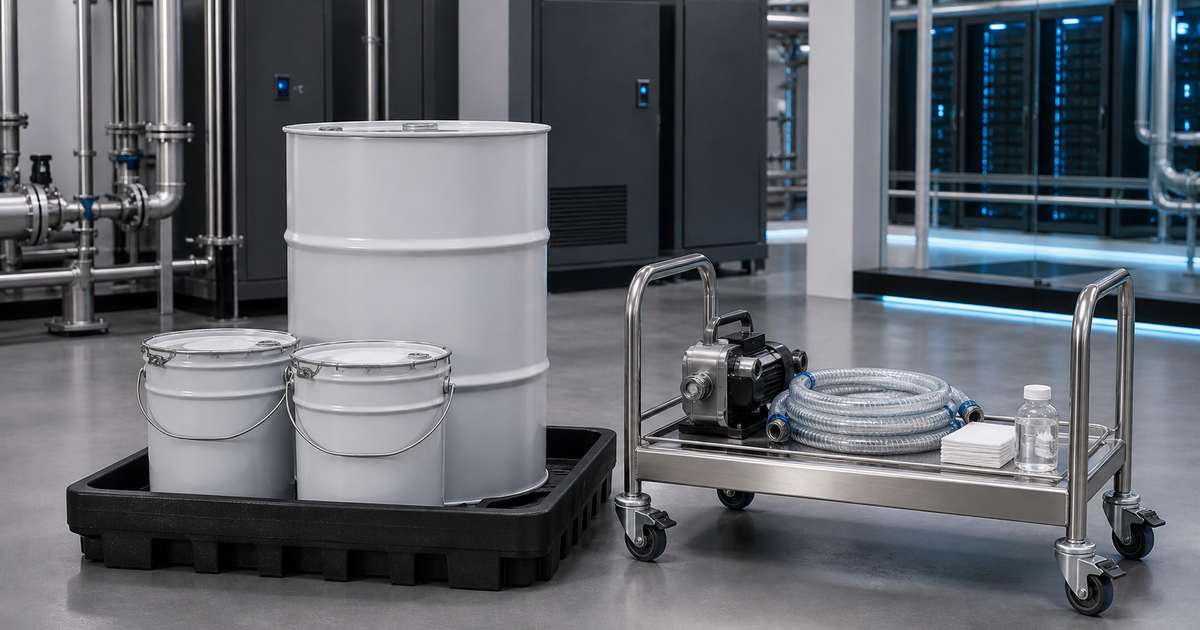
Three handoffs decide whether fluid stays trustworthy
- Receive it. Confirm the product, lot, quantity, seal, and paperwork before the package enters storage.
- Hold it. Keep it inside supplier storage conditions and separate sealed inventory from opened remainders.
- Transfer it. Use clean, dedicated wetted equipment and record the destination, volume, and work order.
Each handoff closes a different gap. Receiving proves what arrived. Storage protects what arrived. Transfer proves what entered the loop.
Remote sites make a small top-up a logistics problem
A campus may keep sealed packages in one controlled facilities area, close to the CDU and the technicians who service it. A remote module has different constraints: less storage, longer service intervals, and no neighboring building from which to borrow the right pail.
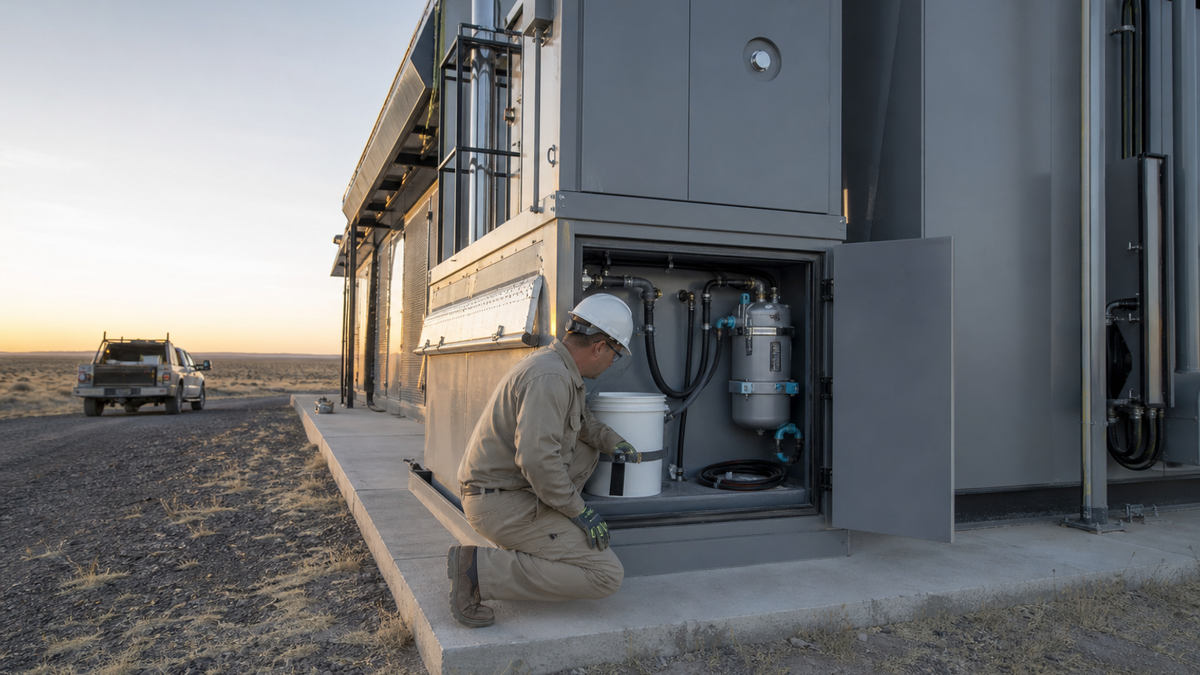
The answer is not simply to stock more. Coolant still ages, packages occupy space, and large containers can create awkward leftovers. The useful inventory is enough matching premix, in a practical package size, placed on a service route the team can support.
Ten liters can change the recipe
Take a 100 L loop at 25 percent propylene glycol. It contains 25 L of glycol. Add 10 L of deionized water and the loop now holds 110 L, but still only 25 L of glycol. The concentration falls to about 22.7 percent.
That calculation is an illustration, not a recommendation to add water. The approved response depends on the system and fluid supplier. It simply shows why a small top-up can change the whole formulation.
Open Compute Project guidance lists 24.5 to 29.5 volume percent propylene glycol for the PG25 fluid specification it describes. Castrol publishes 24.5 to 29 volume percent for its named PG25 product. Use the applicable product and project limits, not the letters PG25 as a substitute for measurement.
Plan the next visit before the alert
A shelf count tells you what you own today. A forecast tells you what each site is likely to need before the next technician arrives.
Start with three inputs: the number of modules, expected makeup per module before the next visit, and a defined planning reserve. Then choose a package size that works for storage and transfer.
Use the planner below to make that tradeoff visible. It is an inventory illustration, not a manufacturer target.
Make every top-up explainable
When a loop changes after maintenance, the record should help answer why. Capture four things:
- Package identity: product, lot, volume, seal state, location, and relevant date.
- Transfer event: who performed it, which loop received it, what equipment was used, and how much was added.
- Loop response: the approved concentration, chemistry, level, pressure, flow, and temperature checks before and after the event.
- Exceptions: unknown fluid, an opened remainder, a leak, a spill, or any break in custody.
Where Reliability Engine fits
Reliability Engine brings makeup events, fluid analysis, loop telemetry, and service history onto one timeline. Teams can see how quickly each site consumes fluid, attach a cause to changes after a top-up, and plan matching inventory before the next visit.
The best emergency container is sealed, approved, traceable, and already on the right route.
Subscribe to updates
Get the latest engineering perspectives sent straight to your inbox.