Inside PG25: The Invisible Chemistry Protecting Every Cold Plate
By Gaurav Dhir
A bottle can look perfectly clear while the chemistry doing the hardest job is invisible.
Inside a cold plate, coolant passes through narrow metal channels again and again. Every pass moves heat, but every pass is also chemical contact. The fluid must cool the chip without encouraging the surfaces around it to become dissolved metal or deposits.
The coolant carries the heat. The inhibitor package helps protect the path.
Start with three parts
- Water carries most of the heat. Its thermal properties make it the main heat-transfer component in a water-glycol mixture.
- Propylene glycol changes the fluid properties. It affects freezing behavior, viscosity, and heat-transfer performance. PG25 usually means roughly one-quarter propylene glycol by volume.
- The inhibitor package supports corrosion control. It is selected for the approved metals, seals, temperatures, and operating conditions.
Two coolants can both carry the PG25 label and still use different water quality, additives, and material approvals. PG25 describes a concentration family, not a universal recipe.
What OAT means in plain English
OAT stands for Organic Acid Technology. In these fluids, organic carboxylate inhibitors are part of the corrosion-control package. They can interact with metal surfaces and interfere with the electrochemical reactions that remove metal.
A useful mental picture is a protection team concentrating on vulnerable locations instead of covering every surface with the same thick layer. The real chemistry is more nuanced, and the exact formulation remains product-specific.
Inorganic inhibitor packages can rely more heavily on film-forming protection. Hybrid packages combine organic and selected inorganic approaches. None of those labels identifies a universal winner. The approved product still has to match the complete loop.
Why cold plates raise the stakes
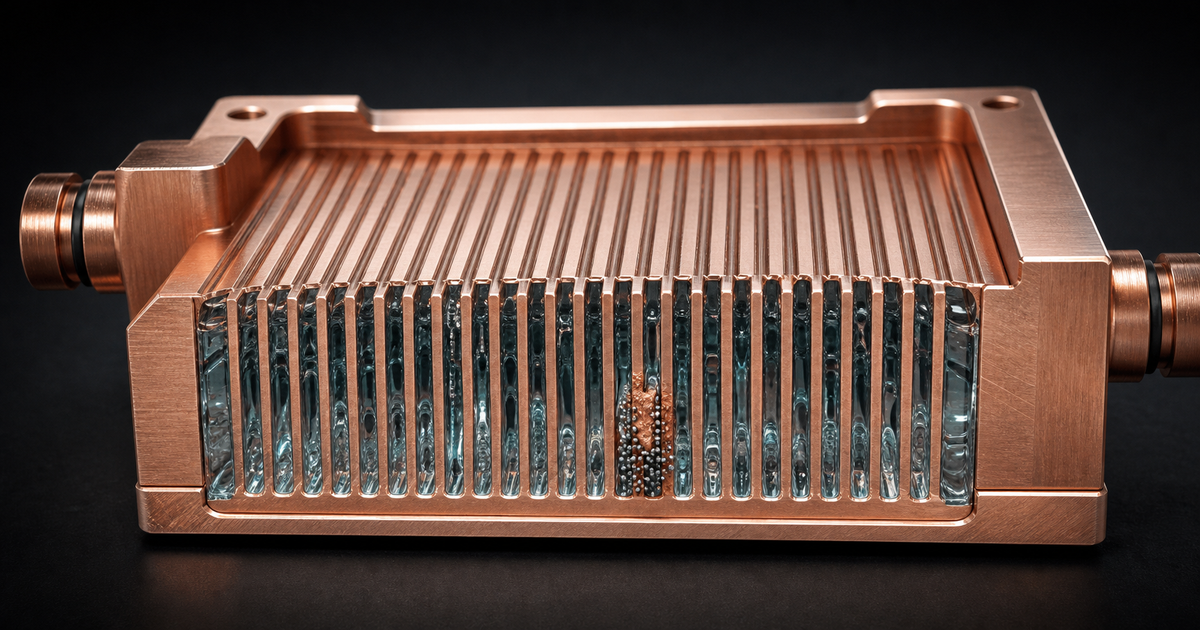
Cold plates gain performance from narrow channels and a large wetted area. That geometry helps heat enter the coolant, but it leaves little room for deposits, incompatible mixtures, or corrosion products.
The first warning may not be a visible leak. Dissolved metal may rise in a sample. Deposits may change branch resistance. Surface changes may alter the boundary where heat enters the fluid. Chemistry, pressure, flow, and temperature can move on different timelines.
This is why the best fluid is not simply the one with the longest advertised life. It is the formulation validated for the actual materials and operating conditions, supported by evidence from the actual loop.
How a fluid proves it can protect the materials
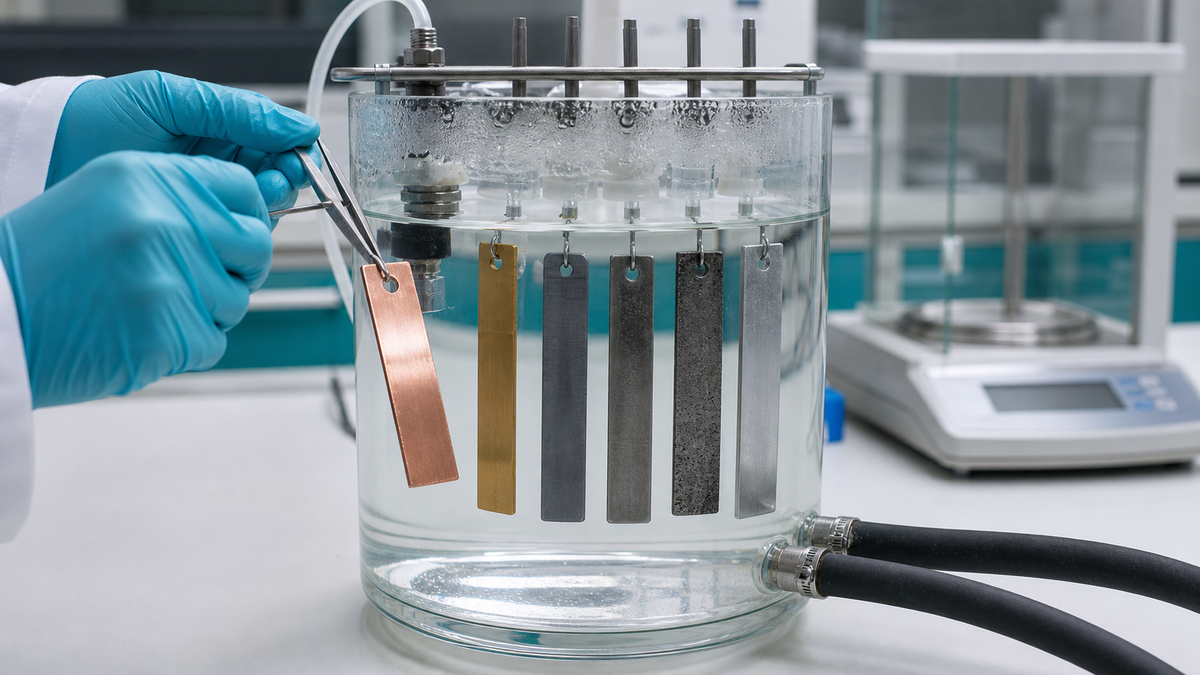
One common approach uses metal coupons. Known samples are exposed to controlled fluid conditions, then cleaned and weighed to measure material loss. It is the laboratory version of asking the coolant to show its work.
The Open Compute Project PG fluid guideline describes a modified ASTM D8040 test and sets maximum corrosion rates for copper and brass under that method. Other product or project qualifications may use different materials and procedures.
Start with the question, not the instrument
A sample does not produce one universal health score. Each check answers a different question:
- Does it look different? Appearance can reveal particles, haze, separation, or an obvious color change. Clear fluid can still have changed chemistry.
- Was it diluted? Propylene glycol concentration shows whether the water-glycol ratio moved. It does not prove the inhibitor package is healthy.
- Did the bulk chemistry shift? pH and, where specified, reserve alkalinity describe different parts of the acid-base condition. Neither identifies every inhibitor.
- Are protection or metals changing? Laboratory inhibitor and elemental analysis can track specified additives and metals when suitable methods and baselines are available.
Choose the question below to see what the corresponding evidence can reveal and what it cannot prove alone.
Numbers need a last name
A limit only makes sense when you know which specification, product, method, and sample location it belongs to.
The OCP guideline lists 24.5 to 29.5 volume percent propylene glycol, pH from 8.0 to 10.5, and unadjusted reserve alkalinity above 4 mL for the PG25 specification it describes. It also notes that pH may be lower with OAT inhibitors.
Castrol publishes 24.5 to 29 volume percent glycol and pH from 8.0 to 9.5 for its named PG25 product. Those values do not conflict. One belongs to an industry guideline and the other to a specific fluid. Neither should be copied into a universal alarm.
A sample is a frame, not the whole film
A bottle captures the fluid at one place and one moment. The loop has a history.
If dissolved copper rises, useful context includes sample location, temperature, oxygen entry, makeup history, concentration, flow, and recent maintenance. If pH changes after a top-up, the event should already be attached to the trend.
Reliability Engine brings fluid analysis, loop telemetry, maintenance events, and the approved baseline onto one timeline. Teams can see whether the chemistry and hardware are still telling the same story and decide what to check next.
Do not ask only whether the coolant looks clear. Ask whether the formulation, the materials, and the operating evidence still agree.
Subscribe to updates
Get the latest engineering perspectives sent straight to your inbox.