Predictive Maintenance: The Role of AI in Cooling Reliability
By Gaurav Dhir
Your GPUs Aren't Failing First. Your Coolant Is.
You're behind the wheel of a custom-built hypercar worth $400,000. The only instrument on the console is a single red bulb that lights up after the engine has already seized. No oil pressure gauge. No temperature needle. No fuel indicator. Just a light that says, "Too late."
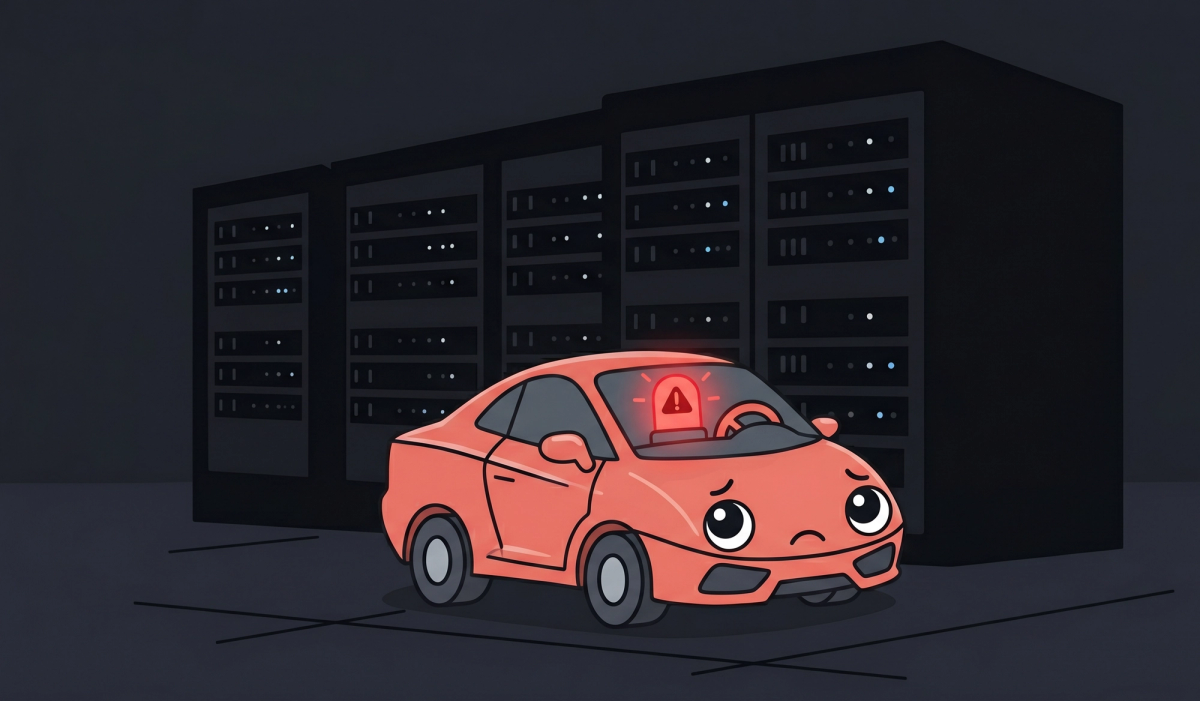
That is how most AI data centers manage their liquid cooling today. They wait for the red bulb. By the time it flickers on, the damage is already done: a corroded cold plate, a clogged micro-channel, a rack of GPUs turned to scrap.
In liquid-cooled GPU racks, catastrophic failures rarely begin as thermal events. They begin as chemistry problems that eventually become thermal problems.
The coolant loop usually signals distress for days before anything overheats, through conductivity drift, rising differential pressure, or particulate loading. The loop was talking the entire time. Nobody was listening.
Predictive maintenance flips this. It gives you a real dashboard.
The Problem With Rearview Mirrors
Today's standard approach works like this. Once a month, a technician pulls a coolant sample, ships it to a lab, and waits a week for a report. The report confirms the fluid was healthy on the day of collection. It says nothing about the three weeks in between.
On the other end sits the Building Management System. Its alarms fire when supply temperature crosses a threshold or the pump fails. These alarms don't warn. They confirm.
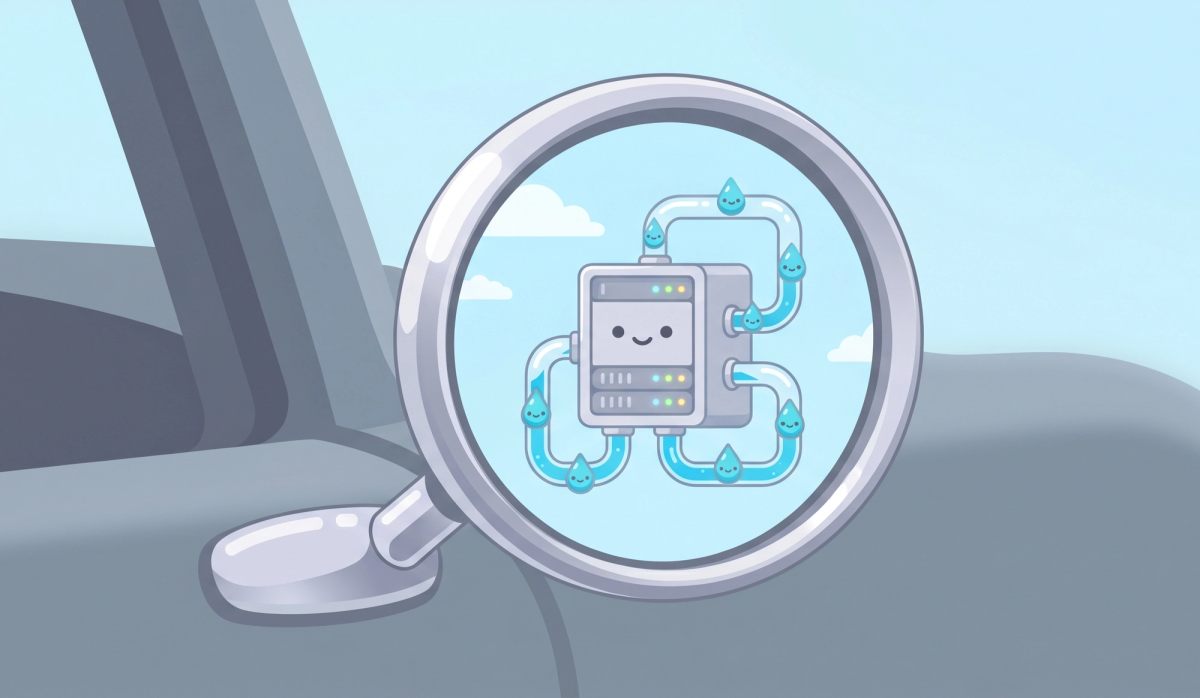
Between the monthly snapshot and the post-disaster alarm lies a silent void where hardware quietly degrades. Now, imagine a partially clogged cold plate on a training cluster running at near-constant utilization. Flow slowly drops over several days.
Bulk supply temperature remains within limits, so nothing trips. Meanwhile, localized hotspots develop inside the microchannels. The rack appears healthy, until one node suddenly throttles during a production run. By then, the damage has been silently accumulating for over a week.
That's not a hypothetical. It's a predictable failure pattern that repeats across facilities because the monitoring gap lets it.
Give Your Cooling Loop a Real-Time Voice
The shift begins with one change: stop sampling and start listening.
Instead of pulling a manual sample once a month, imagine watching the coolant’s health continuously, the way a doctor monitors a patient during surgery.
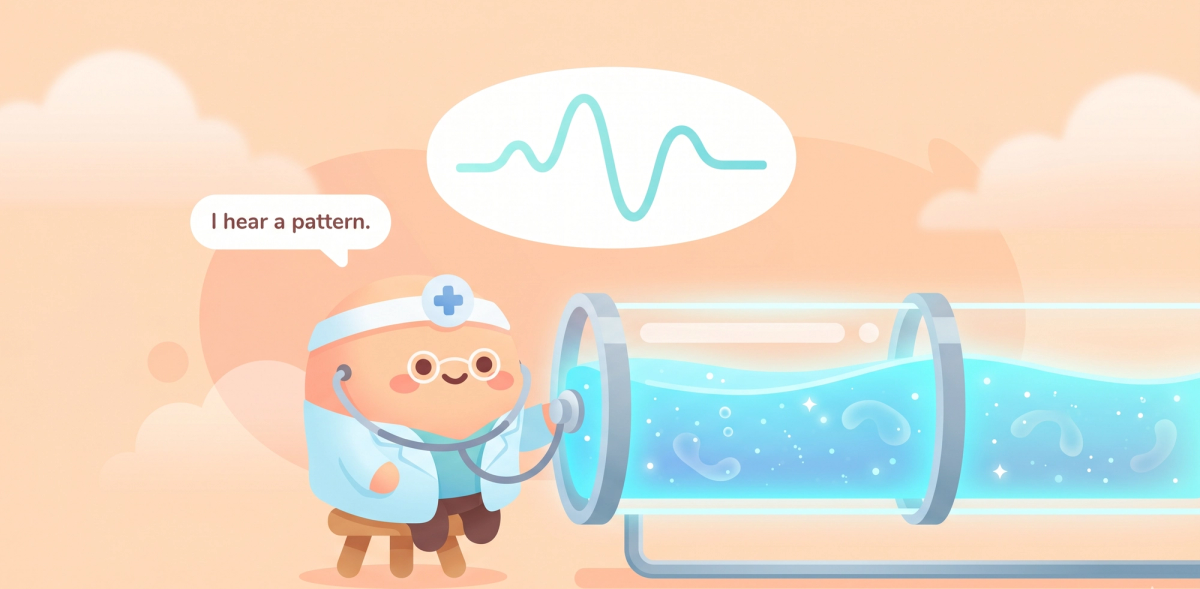
Subtle changes in fluid chemistry, tiny shifts in flow behavior, early signs of corrosion or clogging: these are the quiet indicators that a single lab report will never catch. On their own, each signal is easy to ignore.
Together, over time, they form a chemical signature.
This is where AI enters the picture. Not as a black box, but as a pattern-recognition engine that learns to recognize the fingerprints of failure from the data stream.
It notices when fluid chemistry shifts in ways a human operator would miss: the quiet signals that say corrosion is starting, a filter is loading up, or biology is blooming. These are not guesses. They are early warnings grounded in the physical behavior of the loop itself.
A slow, steady rise in conductivity coupled with a slow drop in pH over 72 hours isn't random noise. It's the fingerprint of active corrosion: metal dissolving into the fluid.
A gradual increase in differential pressure, compared against flow rate, signals a filter loading up. A spike in turbidity without a corresponding pressure change points to a biofilm bloom, not debris.
These are deterministic signals. They are governed by well-understood principles of electrochemistry and fluid dynamics.
The analytics layer simply applies those principles at speed and scale, acting like a detective who never sleeps.
From Detection to Prediction
Spotting a pattern is valuable. Projecting it forward is what changes operations.
Once the system identifies a developing trend, it acts like a forecaster. It extrapolates the trajectory and calculates the moment of impact: "At the current rate, this filter will hit 80% clogged in 10 days."
Now the facilities team has a forecast, not a fire drill. Maintenance can be scheduled during normal working hours. No 3:00 AM scramble. No emergency shutdown.
This capability shifts the role of the facilities team entirely. Instead of reacting to failures, they anticipate them. They plan moves. They optimize.
The industry still treats coolant health as a maintenance problem. In AI infrastructure, it's increasingly a compute availability problem. Most operators obsess over GPU telemetry while remaining nearly blind to the chemistry protecting those GPUs.
The Economics of Listening
Predictive maintenance doesn't just prevent disasters. It changes the financial equation of running a data center.
First, there's the warranty shield. NVIDIA and other OEMs require proof that coolant chemistry stayed within spec throughout the hardware's life. A continuous, time-stamped, tamper-evident data stream provides an unbreakable audit trail.
When a cold plate fails and you can prove the fluid was clean, you have a covered repair. Without that data, you have a denied claim and a very expensive paperweight.
Second, there's the Token Tax. When filters clog or biofilm coats surfaces, the cooling pump must work harder to maintain the same flow rate.
In variable-speed pumping systems, power draw scales approximately with the cube of rotational speed. This means a modest 10% increase in required pressure can translate to a 15 to 20 percent spike in energy consumption.
Every watt eaten by unnecessary friction is a watt stolen from the GPUs. Continuous monitoring catches these slow efficiency losses early, detecting fouling trends 5 to 14 days before threshold alarms would typically trigger, and keeping the power bill focused on compute.
Where This Is Headed
AI infrastructure has become predictive in almost every layer: workloads, orchestration, networking, power management. Cooling is one of the last critical systems still managed reactively. That won't last.
Leading hyperscalers are already moving toward continuous coolant monitoring as a baseline operational capability.
Insurance underwriters are increasingly paying attention to coolant-related operational risk. Within a few years, manual sampling will look as outdated as manually checking server fans.
That gap is precisely where new approaches are emerging. Instead of relying on periodic lab tests or reactive alarms, a new class of monitoring solutions is making it possible to watch coolant health in real time, correlating multiple chemical and physical signals to catch degradation long before it causes damage.
This shift moves cooling from a maintenance afterthought to an integral part of compute reliability.
The next bottleneck in AI infrastructure won't just be power or compute density. It will be coolant reliability.
In high-density AI infrastructure, the cooling loop is no longer auxiliary infrastructure. It is part of the reliability envelope of the compute itself.
The only question is whether your team is still waiting for the red bulb, or already looking at the gauges.
Subscribe to updates
Get the latest engineering perspectives sent straight to your inbox.
References
- Centrifugal Pump Affinity Laws – Governing physics equations demonstrating the cubic relationship between Coolant Distribution Unit (CDU) pump speed and power consumption.
- Open Compute Project (OCP) – Advanced Cooling Facilities guidelines and liquid cooling specifications.
- ASHRAE TC 9.9 – Water Quality Guidelines and thermal limits for Data Center Liquid Cooling Systems.
- NACE-TM0194 (AMPP) – Industry testing standards and latency evaluations for rapid bacterial/SRB monitoring in industrial water systems.
- Uptime Institute – Annual Outage Analysis and Global Data Center Survey (macro-metrics on enterprise downtime costs and hardware failure vectors).
- Commercial Insurance & Risk Underwriting Trends – Evolving carrier policies and risk assessments regarding high-density liquid cooling deployments and continuous fluid maintenance.