Micro-particles, pH drift, conductivity movement, and scaling can appear long before a monthly lab report returns.
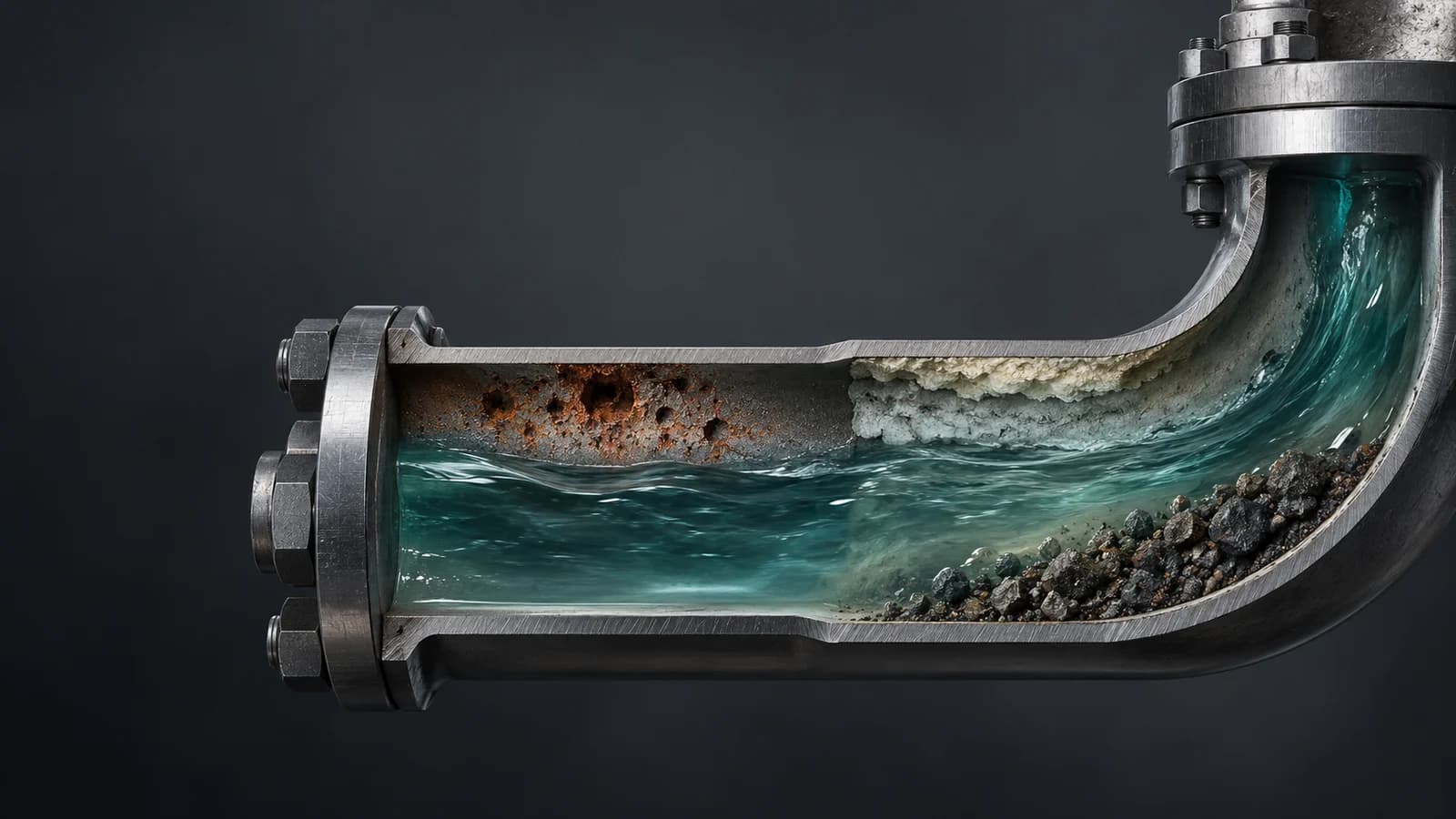
Liquid Cooling Failure Modes
Failure modes
Liquid Cooling Failure Modes Current Systems Miss
Liquid-cooled AI infrastructure is moving from thermal management to chemical management. Pumps and temperatures are visible. Chemistry is often not.
The dangerous failures begin as small chemistry, particle, pressure, and heat-transfer changes before they become a thermal alarm.
A GPU temperature spike may be the last visible symptom of a fluid, flow, or materials problem.
Operators need to know whether to sample, inspect, filter, rebalance, condition, clean, or protect output.
Explore the signal flow
CorrosionElectrochemical metal loss can become leaks, debris, and materials damage.
BiofilmMicrobial growth can coat surfaces and reduce heat transfer.
Micro-channel cloggingParticles can restrict cold plates and raise pump strain.
CavitationLow-pressure vapor collapse can damage surfaces and destabilize flow.
How Reliability Engine works
From cooling measurements to maintenance decisions.
Monitor the loop
Track coolant health, temperature, pressure and flow.
Compare with GPU load
Read loop changes alongside rack and GPU signals.
Check likely causes
Look for coolant changes, restrictions or workload effects.
Choose the next check
Prioritize sampling, inspection or maintenance.
What this helps you see
Corrosion
Electrochemical metal loss can become leaks, debris, and materials damage.
Biofilm
Microbial growth can coat surfaces and reduce heat transfer.
Micro-channel clogging
Particles can restrict cold plates and raise pump strain.
Cavitation
Low-pressure vapor collapse can damage surfaces and destabilize flow.
Eight failure modes to watchView table
| Failure mode | Early signal | Operational risk | Operator move |
|---|---|---|---|
| Corrosion | pH, conductivity, metals, inhibitor movement. | Leaks, debris, materials loss. | Review chemistry and material compatibility. |
| Biofilm | Turbidity, particles, biological indicators, pressure drift. | Insulated heat transfer and contamination. | Sample, filter, and investigate growth conditions. |
| Micro-channel clogging | Pressure drop, particle load, flow imbalance. | Cold-plate restriction and pump strain. | Inspect filters, cold plates, and branch behavior. |
| Inhibitor depletion | Protective chemistry reserve falling. | Higher corrosion and deposit risk. | Condition or replace fluid before damage accelerates. |
| Oxygen ingress | Oxidation markers, bubbles, pH movement. | Corrosion and microbial growth. | Check seals, fill process, and loop exposure. |
| Glycol breakdown | Organic acid formation, pH drop, conductivity rise. | Fluid degradation and corrosion risk. | Review heat exposure and coolant life. |
| Water-quality drift | Minerals, conductivity, scaling indicators. | Deposits and blocked flow paths. | Verify fill water, filtration, and service process. |
| Cavitation | Low pressure, vibration, pump behavior, erosion debris. | Shock damage and unstable flow. | Check pressure window, pump conditions, and restrictions. |
Corrosion
- Early signal
- pH, conductivity, metals, inhibitor movement.
- Operational risk
- Leaks, debris, materials loss.
- Operator move
- Review chemistry and material compatibility.
Biofilm
- Early signal
- Turbidity, particles, biological indicators, pressure drift.
- Operational risk
- Insulated heat transfer and contamination.
- Operator move
- Sample, filter, and investigate growth conditions.
Micro-channel clogging
- Early signal
- Pressure drop, particle load, flow imbalance.
- Operational risk
- Cold-plate restriction and pump strain.
- Operator move
- Inspect filters, cold plates, and branch behavior.
Inhibitor depletion
- Early signal
- Protective chemistry reserve falling.
- Operational risk
- Higher corrosion and deposit risk.
- Operator move
- Condition or replace fluid before damage accelerates.
Oxygen ingress
- Early signal
- Oxidation markers, bubbles, pH movement.
- Operational risk
- Corrosion and microbial growth.
- Operator move
- Check seals, fill process, and loop exposure.
Glycol breakdown
- Early signal
- Organic acid formation, pH drop, conductivity rise.
- Operational risk
- Fluid degradation and corrosion risk.
- Operator move
- Review heat exposure and coolant life.
Water-quality drift
- Early signal
- Minerals, conductivity, scaling indicators.
- Operational risk
- Deposits and blocked flow paths.
- Operator move
- Verify fill water, filtration, and service process.
Cavitation
- Early signal
- Low pressure, vibration, pump behavior, erosion debris.
- Operational risk
- Shock damage and unstable flow.
- Operator move
- Check pressure window, pump conditions, and restrictions.
From the library
Engineering guides
Coolant Monitoring, Maintenance and Troubleshooting
Build a practical coolant monitoring program for direct-to-chip cooling, with sampling, hydraulic checks, maintenance decisions and incident evidence.
Read guideCoolant Chemistry and Filtration for Liquid CoolingSelect, test and maintain liquid cooling coolant with a practical guide to chemistry, material compatibility, filtration, sampling and corrective action.
Read guideCommon questions
What liquid cooling failure modes are hardest to see?
Chemical and fluid-driven modes are hardest to see early: corrosion, biofilm, particles, inhibitor depletion, oxygen ingress, glycol breakdown, water-quality drift, and cavitation.
Why are lab reports not enough?
A delayed lab report may arrive after chemistry drift, scaling, particles, or thermal symptoms have already affected the loop. Continuous context helps close that delay.
Which signals reveal failure modes early?
Useful early signals include pH, conductivity, turbidity, particles, inhibitor health, pressure drop, flow variance, filter behavior, and thermal response under workload.