If commissioning starts with contamination, trapped debris, unstable chemistry, or poor branch balance, later monitoring becomes harder to interpret.
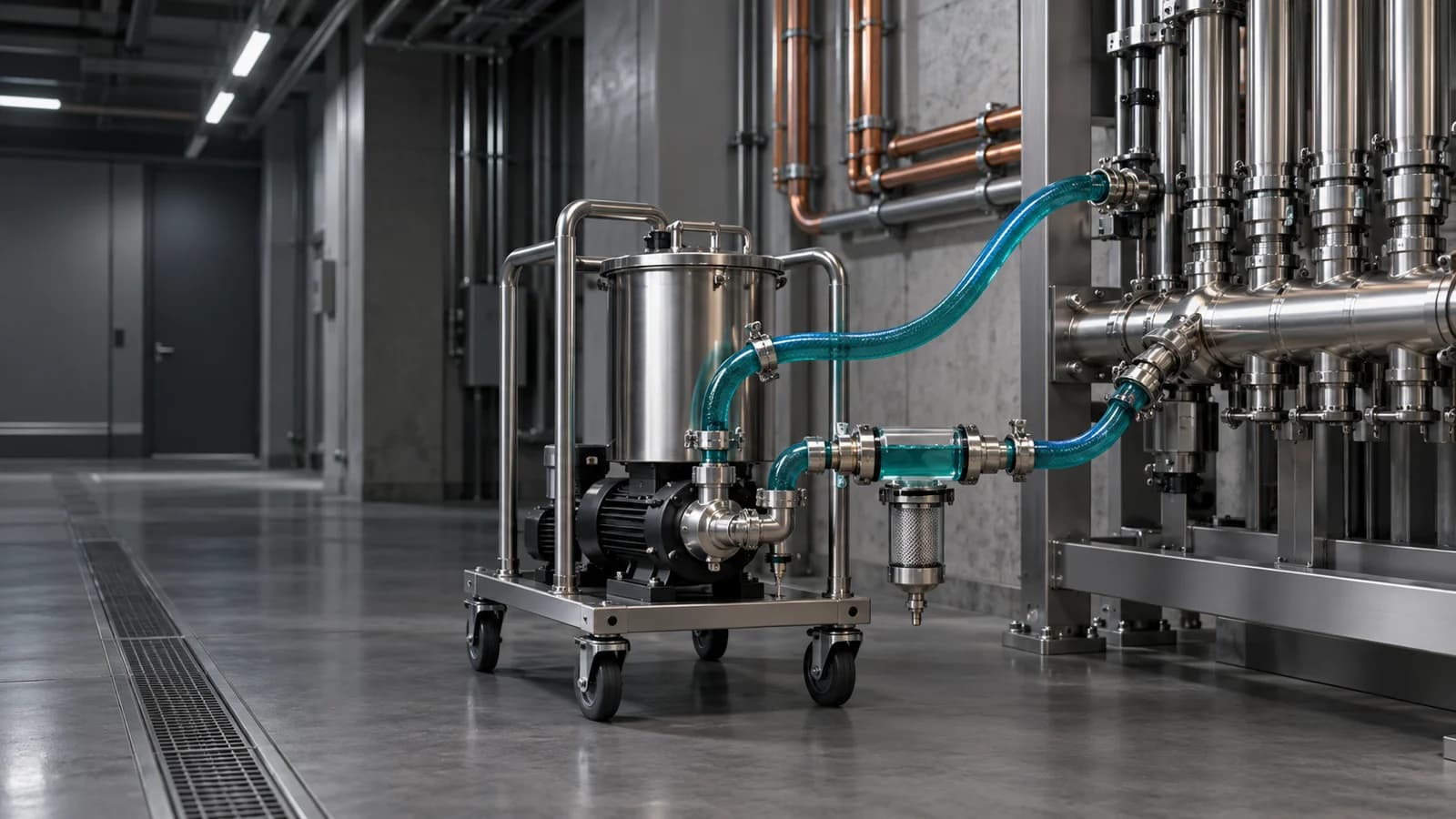
Clean Loop Commissioning
Commissioning
Clean Loop Commissioning for Liquid-Cooled AI Infrastructure
Clean loop commissioning establishes the baseline that future reliability decisions depend on.
Reliability Engine helps teams understand whether a new or serviced loop begins with stable coolant, hydraulic behavior, filtration, and thermal response.
Capture coolant condition, filter response, pressure profile, flow distribution, thermal response, and service history while the loop is known to be clean.
A trusted baseline makes future drift easier to detect and turns maintenance events into measurable before-and-after comparisons.
Explore the signal flow
Fluid baselineRecord chemistry, particles, turbidity, and inhibitor health at handover.
Hydraulic baselineCapture pressure and flow behavior under expected operating conditions.
Thermal baselineUnderstand heat-transfer behavior at real workload.
Service recordTie flushing, filling, filtration, and conditioning events to the data history.
How Reliability Engine works
From cooling measurements to maintenance decisions.
Monitor the loop
Track coolant health, temperature, pressure and flow.
Compare with GPU load
Read loop changes alongside rack and GPU signals.
Check likely causes
Look for coolant changes, restrictions or workload effects.
Choose the next check
Prioritize sampling, inspection or maintenance.
What this helps you see
Fluid baseline
Record chemistry, particles, turbidity, and inhibitor health at handover.
Hydraulic baseline
Capture pressure and flow behavior under expected operating conditions.
Thermal baseline
Understand heat-transfer behavior at real workload.
Service record
Tie flushing, filling, filtration, and conditioning events to the data history.
Commissioning checksView table
| Check | What it confirms | Risk if missed | Operator move |
|---|---|---|---|
| Coolant chemistry baseline | The fluid begins in a protective window. | Early corrosion or instability is missed. | Record pH, conductivity, turbidity, and inhibitor state. |
| Particle trend after startup | Debris is falling rather than rising. | Filter loading and cold-plate fouling risk remain hidden. | Track particle movement across early operation. |
| Pressure and flow signature | The loop distributes coolant predictably. | Branch imbalance becomes normalized. | Record healthy hydraulic behavior. |
| Thermal response at workload | The loop transfers heat as expected. | Future drift has no clean comparison point. | Store clean thermal behavior as the reference. |
Coolant chemistry baseline
- What it confirms
- The fluid begins in a protective window.
- Risk if missed
- Early corrosion or instability is missed.
- Operator move
- Record pH, conductivity, turbidity, and inhibitor state.
Particle trend after startup
- What it confirms
- Debris is falling rather than rising.
- Risk if missed
- Filter loading and cold-plate fouling risk remain hidden.
- Operator move
- Track particle movement across early operation.
Pressure and flow signature
- What it confirms
- The loop distributes coolant predictably.
- Risk if missed
- Branch imbalance becomes normalized.
- Operator move
- Record healthy hydraulic behavior.
Thermal response at workload
- What it confirms
- The loop transfers heat as expected.
- Risk if missed
- Future drift has no clean comparison point.
- Operator move
- Store clean thermal behavior as the reference.
From the library
Engineering guides
Liquid Cooling Commissioning and Clean Loop Readiness
Commission liquid cooling with staged clean-loop acceptance, approved flushing methods, fluid verification, performance tests and an evidence-based handover.
Read guideLiquid Cooling Design and Specification for MEP EngineersSpecify data-center liquid cooling with clear FWS and TCS boundaries, coolant requirements, hydraulic checks, monitoring provisions and acceptance criteria.
Read guideCommon questions
What is clean loop commissioning?
Clean loop commissioning is the process of starting or handing over a liquid-cooling loop with verified coolant condition, filtration behavior, pressure and flow stability, and thermal response.
Why does commissioning affect future reliability?
Commissioning creates the reference baseline. If that baseline is unclear or contaminated, future drift is harder to interpret.
What belongs in the commissioning record?
The record includes coolant chemistry, particles, turbidity, inhibitor health, filter behavior, pressure, flow, thermal response, workload state, and service events.