The secondary loop is where facilities, coolant, and compute overlap. It needs its own reliability view.
Reliability Layer
Reliability layer
Put the coolant loop in the same conversation as the GPU.
Facilities teams see the cooling plant. IT teams see the cluster. The rack-level loop where coolant meets the GPU is still too easy to miss.
Reliability Engine gives that loop a home: fluid condition, pressure, flow, workload, service history, and risk in one place.
Coolant telemetry, GPU context, and loop behavior belong together, not scattered across separate dashboards.
The point is to help teams inspect, sample, rebalance, condition, clean, protect output, and verify recovery earlier.
Explore the signal flow
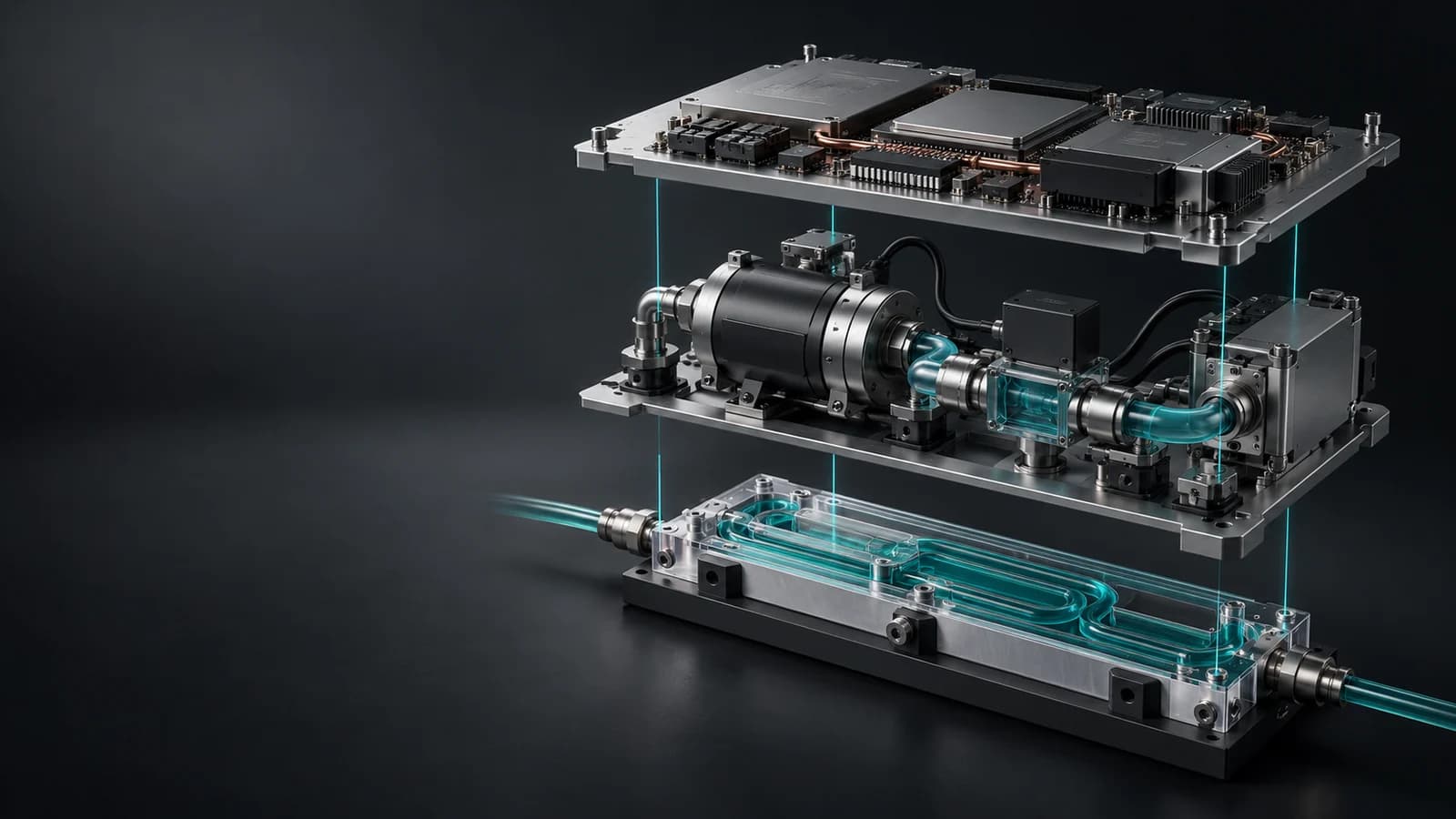
Secondary loopThe rack-level loop where coolant, cold plates, branch behavior, and GPUs interact.
Side-stream sensingA side-stream device can watch loop health without interrupting primary coolant flow.
GPU contextDCGM and workload signals explain whether cooling drift is affecting GPU output.
Recommended actionA mature reliability layer can recommend or trigger measured actions once trust is proven.
Reliability layer
Chemistry, data, and action before failure.
Reliability Engine turns coolant condition and loop behavior into a clear next move before margin disappears.
Catch the change in coolant.
Changes in coolant condition can give operators an earlier reason to investigate.
Predictive Reliability
Turn live chemistry and thermal signals into early operating decisions.
Deep Chemistry Expertise
Understand the liquid before it becomes the reliability risk.
Data Intelligence at Scale
Convert loop data into a clean operating signal for dense infrastructure.
Proven Efficiency and Safety
Protect thermal margin, uptime, and GPU output without adding noise.
Future-Ready Solutions
Built for higher rack densities, hotter chips, and more autonomous loops.
How Reliability Engine works
From cooling measurements to maintenance decisions.
- InputSide-stream coolant signal
- ContextRack and GPU behavior
- ModelKnown-good baselines
- OutputA practical next step
Where it sits
A thin product layer above the loop.
Reliability Engine is not trying to replace the CDU, the BMS, or GPU telemetry. It reads across them so operators can see what the loop is doing and what changed.
Side-stream coolant signal
Chemistry, particles, turbidity, and inhibitor movement give the loop an early voice.
Rack and GPU behavior
Pressure, flow, filters, service events, workload, and thermal margin explain what the signal means.
Known-good baselines
Live behavior is compared with clean operation so small drift is not buried in workload noise.
A practical next step
Operators see where to look, what to check, and whether the loop recovered after action.
What this helps you see
Secondary loop
The rack-level loop where coolant, cold plates, branch behavior, and GPUs interact.
Side-stream sensing
A side-stream device can watch loop health without interrupting primary coolant flow.
GPU context
DCGM and workload signals explain whether cooling drift is affecting GPU output.
Recommended action
A mature reliability layer can recommend or trigger measured actions once trust is proven.
What the reliability layer connectsView table
| Layer | Signals | Question answered | Operator value |
|---|---|---|---|
| Facilities | CDUs, pumps, filters, manifolds, pressure, flow. | Is the loop moving coolant predictably? | Find hydraulic drift before it becomes a compute issue. |
| Coolant | pH, conductivity, turbidity, particles, inhibitors, chemistry movement. | Is the fluid still protective? | Catch chemical and contamination risk earlier. |
| Compute | GPU temperature, workload state, throttling, utilization, thermal margin. | Is cooling health affecting useful output? | Prioritize risks that matter to operators. |
| Action | Recommended action, setpoints, workload protection, verification. | What should happen next? | Move from signal to trusted response. |
Facilities
- Signals
- CDUs, pumps, filters, manifolds, pressure, flow.
- Question answered
- Is the loop moving coolant predictably?
- Operator value
- Find hydraulic drift before it becomes a compute issue.
Coolant
- Signals
- pH, conductivity, turbidity, particles, inhibitors, chemistry movement.
- Question answered
- Is the fluid still protective?
- Operator value
- Catch chemical and contamination risk earlier.
Compute
- Signals
- GPU temperature, workload state, throttling, utilization, thermal margin.
- Question answered
- Is cooling health affecting useful output?
- Operator value
- Prioritize risks that matter to operators.
Action
- Signals
- Recommended action, setpoints, workload protection, verification.
- Question answered
- What should happen next?
- Operator value
- Move from signal to trusted response.
From the library
Engineering guides
Coolant Monitoring for Equipment Manufacturers and Integrators
Plan coolant monitoring for CDUs, racks and cooling equipment with qualification requirements for sampling, sensors, data contracts, service and warranty.
Read guideIntegrating Liquid Cooling Signals Into BMS and DCIMIntegrate liquid cooling telemetry into BMS and DCIM with a point dictionary, timestamp rules, data quality, alarm lifecycle and commissioning requirements.
Read guideCommon questions
What is the reliability layer for liquid-cooled compute?
It is the operating layer that connects coolant condition, loop telemetry, GPU context, and recommended actions so teams can respond before cooling drift threatens GPU output.
Why is the secondary loop important?
The secondary loop is where facility equipment, coolant chemistry, cold plates, and GPUs interact. Problems there can affect thermal margin even when facilities and IT dashboards look separate.
How does this move toward action?
The path starts with observability, then adds explanation, recommendations, setpoint guidance, workload protection logic, and verification after each action.