The New Connector Fits. Does the Evidence?
One connector half has changed. Here is what UQD v2 testing can tell you about the new pair, and what still needs checking.
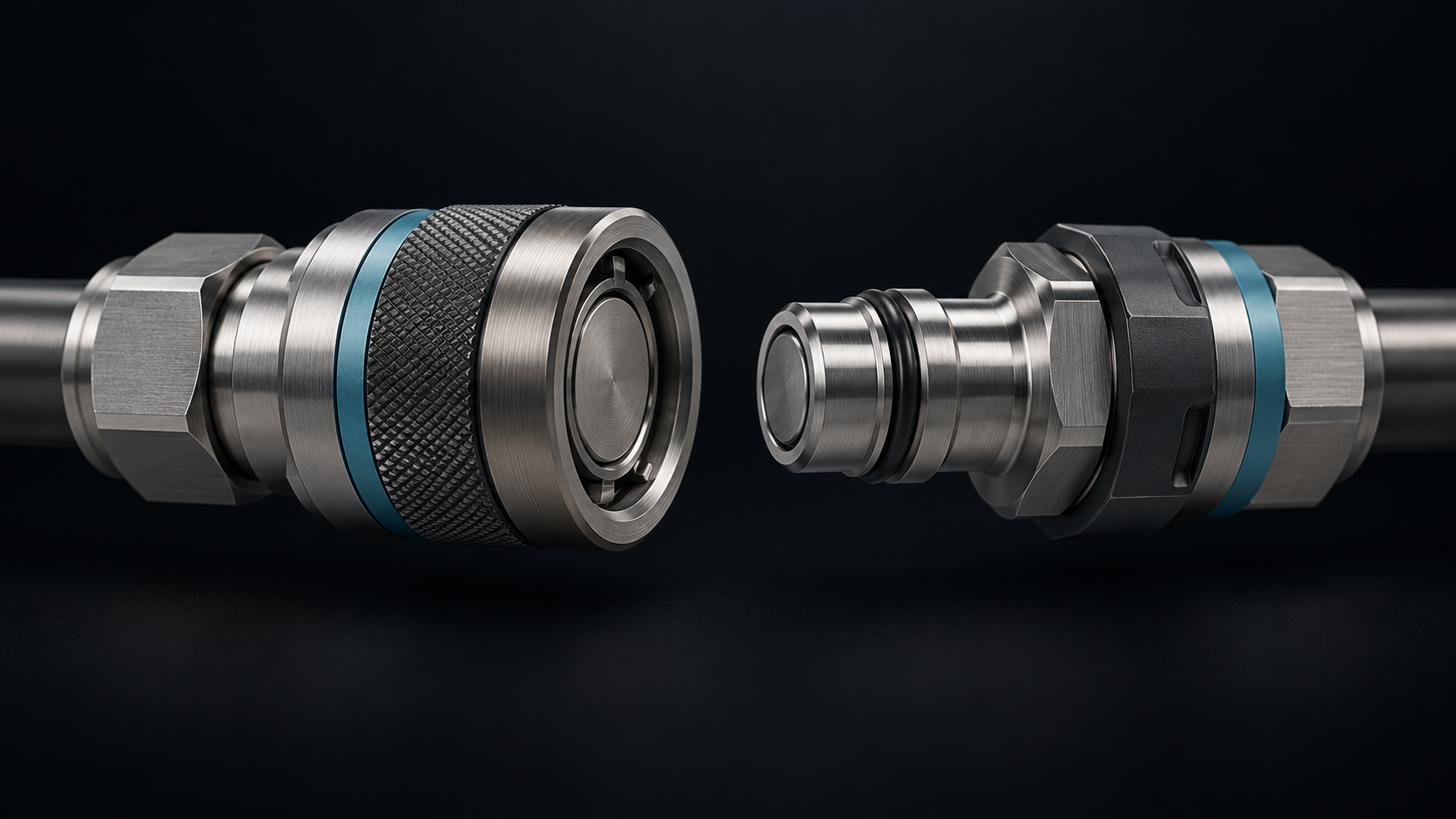
A replacement quick disconnect plug arrives for a cooling branch. It is the right nominal size, clearly marked UQD04 v2, and clicks into the socket that has been in the rack since commissioning. The joint stays dry. So far, so good.
But the socket has not changed, and its history matters just as much as the new plug's. Before returning the branch to service, the team still needs to know whether these two parts have been tested together, whether the valves are fully open and whether the branch returns to its accepted flow and pressure.
That is where a reassuring word like "compatible" can hide several different questions. The Open Compute Project's Universal Quick Disconnect specification helps separate them. Its testing has clear boundaries, especially when a new half meets an older one.
First, find out what was actually tested
UQD v2.0.0 took effect on September 22, 2026. It covers handmate UQD connectors, blindmate UQDB connectors and the hybrid of a UQD plug blindmated into a UQDB socket, in single-phase water and glycol cooling loops. It sets the interface dimensions and the performance that every supplier's parts must meet, so that parts from different suppliers can work together.
There are two kinds of test evidence. The names sound similar, but they answer different questions (sections 9 and 10).
Two kinds of v2 evidence
Supplier verification
- Who tests
- Each supplier, on its own plugs and sockets
- Tests
- Burst, fluid loss, force to connect, pressure drop and seal washout, then shipping and operating temperature cycling, 5,000 coupling cycles and hydrostatic leak checks
- Samples
- At least 5 per test
- Where to find it
- Report on request; part of an OCP Marketplace listing
Supplier cross-verification
- Who tests
- Each supplier, with at least 3 other suppliers
- Tests
- Fluid loss, force to connect, pressure drop and seal washout
- Samples
- At least 3 per test
- Where to find it
- Published list of suppliers whose parts passed; reports on request
Neither covers a pair that mixes v1 and v2 parts. Source: UQD v2.0.0, sections 9 and 10.
The important distinction is what is missing from the mixed-pair test. Cross-verification does not include burst testing or the longer thermal and mechanical sequence. Those results come from each supplier's own verification, using its own parts.
Section 6.1 says version 2 is designed to be backwards compatible with the earlier, separate version 1 specifications for UQD and UQDB, and it encourages end users to assess their own deployments. Section 10 is explicit that cross-verification across versions is not in scope. Differences in performance, features or dimensions "should be evaluated by the end user when considering mixed version deployments."
In other words, a list of approved suppliers is not a blanket approval for every combination of their parts. A v2 plug on a v1 socket sits outside the required v2 cross-verification, even if both suppliers appear on each other's lists. Choose a pairing below to see what evidence to request.
Evidence scope
Which document covers which test?
Choose a pairing. See the evidence to request before a replacement goes into service.
Supplier verification
Request the report for these parts.
The supplier tests its own plug and socket. Check identities and configurations against the report.
Four cross-verification tests
A listing is not the report.
Fluid loss, connection force, pressure drop and seal washout. Confirm the named parts in the report.
Pair evidence still open
Ask both suppliers.
The v2 marking describes each half. It does not establish that this particular combination was tested.
Outside v2 cross-verification
A new pairing needs its own review.
The required cross-verification does not cover a v1/v2 combination. Check the mixed-version guidance.
Identify the retained half
Do not infer a version from fit.
Record supplier, part number, revision and version before choosing the applicable evidence.
See all eight evidence checks
The older half deserves a closer look
The specification's appendix lists what to consider when v1 and v2 parts are mixed. It is reference material, not a requirement, but it reads as a precise checklist (appendix 15.1):
- Plug tip. Version 1 did not define the plug end condition. A v1 plug with little or no chamfer may damage the seals of both v1 and v2 sockets.
- Length and diameter. Version 1 did not define overall length or maximum outside diameter, so a v1 part may need the original panel spacing and pitch.
- Flow. Version 2 raised the minimum flow coefficient. A v1 pair may have a higher pressure drop across its valves than a v2 pair.
- Coupling. Version 1 set only a minimum valve stroke, and tolerance stacks in the internal valving could stop some v1 sets from coupling fully.
- Blindmate tolerance. v1 UQDB systems without built-in tolerance compliance may see variation in coupling panel distance and in flow. Version 2 replaces the minimum engagement requirement with guidance to ensure full coupling at the hard-stop.
A dry joint can still restrict flow
The seal and the valves do different jobs. A seal can keep coolant inside while a partly opened valve still makes it harder to pass through. That is why looking for a leak cannot replace checking full engagement.
In a non-spill quick disconnect, each half contains a valve, and the valves open as the halves engage. CPC's flow dynamics guide explains that for blindmate couplings the connected length directly affects pressure drop, because the valves can sit anywhere between full flow and full shutoff. It recommends an axial tolerance window that suits the system.
UQD v2 measures blindmate and hybrid pairs at the fully mated hard-stop. A pair that stops short of the hard-stop is outside the condition its pressure-drop result describes, even if it is dry.
The cutaway below separates those two events. Its stroke scale explains the sequence, not the dimensions or valve travel of a particular product. Compare full engagement with a connection that stops early.
Valve engagement
Dry is not the same as fully open
Watch the seal close before the valves fully open. Then compare a pair that stops short.
Compare full engagement with a pair that stops short. Both are sealed, but their valve openings differ.
Apart. Both valves are closed. Nothing flows and nothing leaks.
Fully engaged
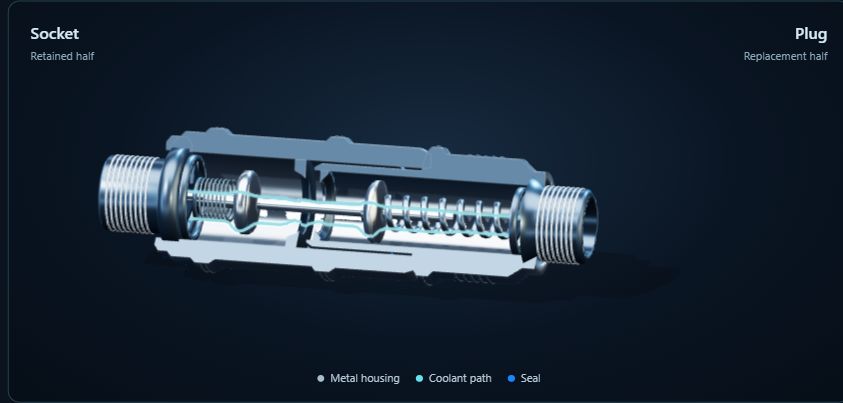
At the hard-stop, both valves are fully open.
Stopped short
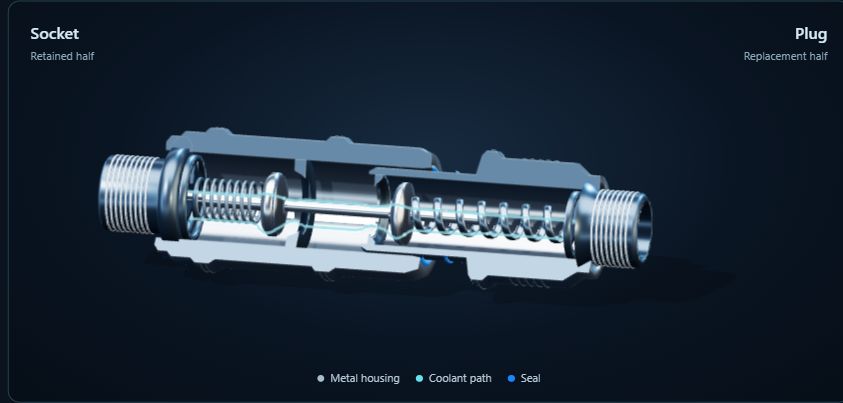
The seal has engaged, but the valve opening is restricted.
Read the pressure-drop result with its conditions
Outside size says little about flow. CPC's guide states that external connector dimensions are not a good indicator of flow coefficient. UQD v2 sets a flow-coefficient band for each size (Table 6) and defines how pressure drop is measured (section 9.1.4):
- water at 25 °C, within 5 °C either way
- at least six flow rates from 25 to 150 percent of the size's rated flow
- each flow direction, with the test fittings' own loss subtracted
- a fitted curve P(Q) = AQ² + BQ, with P in psi and Q in liters per minute, plus the drop at 100 and 150 percent of rated flow
- the minimum flow coefficient, Cv, at rated flow in both directions
Cv is the flow in US gallons per minute that gives a 1 psi drop with water. The specification notes that it is reported relative to water: for other coolants, apply correction factors or test further. A glycol branch at operating temperature is not the test condition.
Put numbers to it. For a size 04 pair at its rated flow of 6.44 liters per minute, the v2 range of Cv 1.1 to 1.6 gives roughly 1.1 to 2.4 psi (0.08 to 0.16 bar) with water. This calculation uses constant Cv; it is not a supplier's measured test curve.
A branch with a supply and a return connector carries two such pairs, alongside filters, manifolds and bends that the CPC selection guide also asks designers to count. Our April article on pressure budgets shows how quickly losses like these use up a rack's allowance.
Flow and pressure
A smaller flow path costs more pressure
Move the flow slider. Compare a lower-Cv pair with the v2 Cv range.
Compare the calculated pressure range for size 04 with a lower-Cv pair. Open the values below for every size.

Calculation, limits and values for every size
Pressure drop for one coupled pair, one flow direction, with water: drop in psi = (flow in gpm / Cv) squared. Cv bands and rated flows are from UQD v2.0.0, Table 6. Real results are fitted as P(Q) = AQ² + BQ and differ by direction and by part. The hypothetical pair is an example of a lower Cv, such as appendix 15.1 warns a v1 pair may have. It is not a published value. Glycol and other temperatures need the supplier's correction or further testing.
Scroll the table sideways on smaller screens. Keyboard: focus the table, then use the arrow keys.
| Size | Rated flow, L/min (gpm) | v2 Cv, max to min | Drop at rated flow | Drop at 150% |
|---|---|---|---|---|
| 02 | 2.27 (0.60) | 0.43 to 0.3 | 1.9 to 4.0 psi 0.13 to 0.28 bar | 4.4 to 9.0 psi |
| 04 | 6.44 (1.70) | 1.6 to 1.1 | 1.1 to 2.4 psi 0.08 to 0.16 bar | 2.5 to 5.4 psi |
| 06 | 11.36 (3.00) | 3.3 to 2.2 | 0.8 to 1.9 psi 0.06 to 0.13 bar | 1.9 to 4.2 psi |
| 08 | 17.79 (4.70) | 5.6 to 3.6 | 0.7 to 1.7 psi 0.05 to 0.12 bar | 1.6 to 3.8 psi |
Now lower Cv by 20 percent from the v2 minimum. Holding the same flow takes about 56 percent more pressure drop. Holding the same pressure drop instead delivers 20 percent less flow. Switch between the two views above to see the trade-off. The specification gives no v1 Cv value, so the 20 percent reduction is an assumed comparison, not a claim about a particular v1 part.
Record both halves when one changes
Replacing just the plug creates a new pairing. The record needs both identities, not just the part number on the delivery note. It should also show which evidence covers the pair and what happened when the branch returned to service.
| Record | Why it matters |
|---|---|
| Both halves: supplier, part number, revision, size, configuration (handmate, blindmate or hybrid) and termination | A report covers named parts, not a connector family or a size |
| The marked version of each half, or "unknown" | A mixed-version pair is outside the required v2 scope; an unknown version leaves that scope unconfirmed |
| The evidence for this pair: a verification report reference, the cross-verification list entry, or a mixed-version assessment | Each document covers a different set of tests |
| How full engagement was confirmed under the equipment procedure | Pressure-drop results describe a fully coupled pair |
| Coolant and temperature in the branch | v2 results are for water at 25 °C |
| Flow and pressure at the same points before and after the change | Shows whether the branch returned to its accepted condition |
If the branch is drained and refilled, note how flow was introduced. The specification warns that in open-loop filling, extreme pressure drop and line velocity across a UQD valve set can wash a valve seal out of its gland, so fill and drain should bring in flow and pressure progressively, within ratings (section 9.1.5).
A missing report is not a failed test, and a report for a different pair is not a failed test either. Both are open questions to settle with the supplier before the substitution is approved. Isolation, draining, reconnection, refilling and return to service belong to the equipment instructions and the site's authorized procedure.
A better question for the supplier
Instead of asking whether a connector is compatible, send both identities and the intended use:
We plan to keep this socket (supplier, part number, revision, marked version) and install this plug (same details) in a handmate, blindmate or hybrid connection carrying our coolant at our operating temperature and flow. Please send the verification or cross-verification report that covers this exact pairing, or confirm that none exists. If the halves are different versions, tell us what has been evaluated for this combination.
A useful answer names a document and the parts it covers. If that evidence is missing, keep the question in the change review. The next shift should not have to guess what "compatible" meant.
Where Reliability Engine fits
Component documents describe what a pair did on a test bench. After a change, the open question is what the installed branch is doing. Reliability Engine's Virtual Chemist brings coolant condition, loop telemetry such as flow, temperature and pressure at rack inlets and outlets, and available GPU context into one view, so a team can check whether a branch returned to its accepted condition after an intervention like a connector replacement.
It does not certify connector pairs, approve substitutions or replace supplier reports and site acceptance. To track branch evidence through maintenance changes, talk to Reliability Engine.
Subscribe to updates
Get the latest engineering perspectives sent straight to your inbox.
References
- Open Compute Project: Universal Quick Disconnect (UQD) Design Specification v2.0.0, effective September 22, 2026. Sections 6.1, 8, 9, 10 and 11, and appendix 15.1.
- CPC: Why Fluidic Flow Dynamics Are Critical to the Design of High-Performance Electronics, 2023. Pages 5 and 6.
- CPC: The ABCs of Quick Disconnects, Part 2, 2025. Flow rate and system pressure drop.
- Reliability Engine: Understanding Pressure Drop in Liquid Cooling, April 22, 2026.
- Reliability Engine: Virtual Chemist, product page, read October 11, 2026.